Overall
4.0
/ 10
7-Iron
Jul 4, 2026, 8:08 PM
Camera: face-on (suboptimal)
You have genuinely good stability, posture ingredients and balance, but the swing is currently powered almost entirely by lifting the arms with virtually no body rotation (shoulder turn ~4°, hips ~1° open at impact, finish turn ~8°). That single issue caps the score — everything downstream (power, path, contact) depends on rotation. Fix the turn and this jumps quickly.
Since Last Session
Your #1 priority for several sessions has been 'make a real shoulder turn — rotate, don't lift.' Honest verdict: it hasn't moved. Shoulder turn measured ~3.7° today, identical to your 2026-07-04 session and actually down from ~13.9° back on 6/30, and X-factor is stuck around 3°. The lifting-with-the-arms pattern is deeply grooved, so we're keeping this as priority #1 but changing the approach — instead of thinking about the club, do the cross-arm and club-across-shoulders drills with NO club so your brain learns the pure body turn first. Master the turn empty-handed, then add the club.
3 swings detected in this clip — the clearest one was analyzed. Tempo across swings: 2.03:1 ±1.97 — lower spread means a more repeatable swing.
Swing Replay
Original recording (no overlay)
Measured Biomechanics
Measured from 3D pose estimation (±5° / ±2 cm). Green bands are beginner reference ranges for a full iron swing, not absolutes.
Key Frames
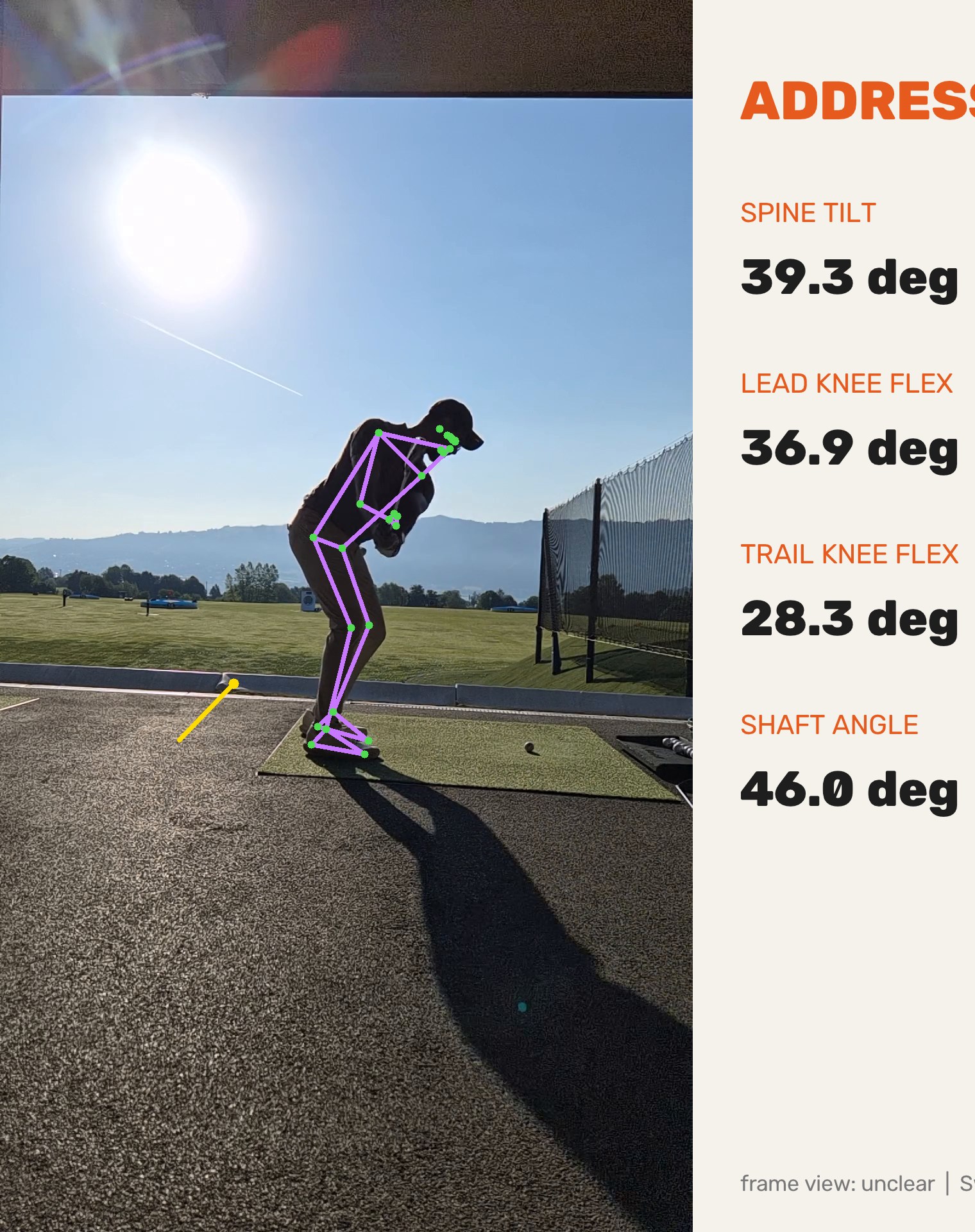
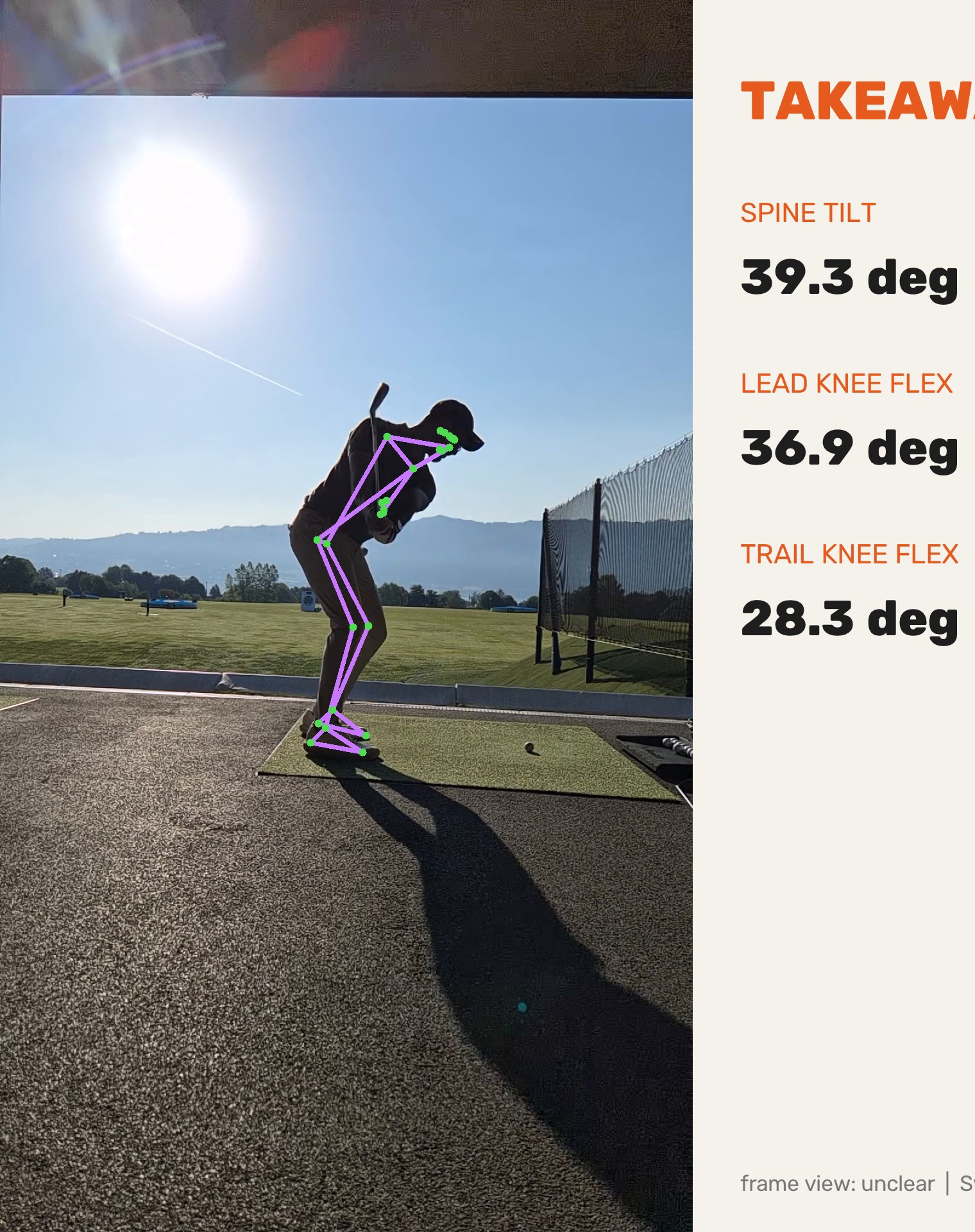
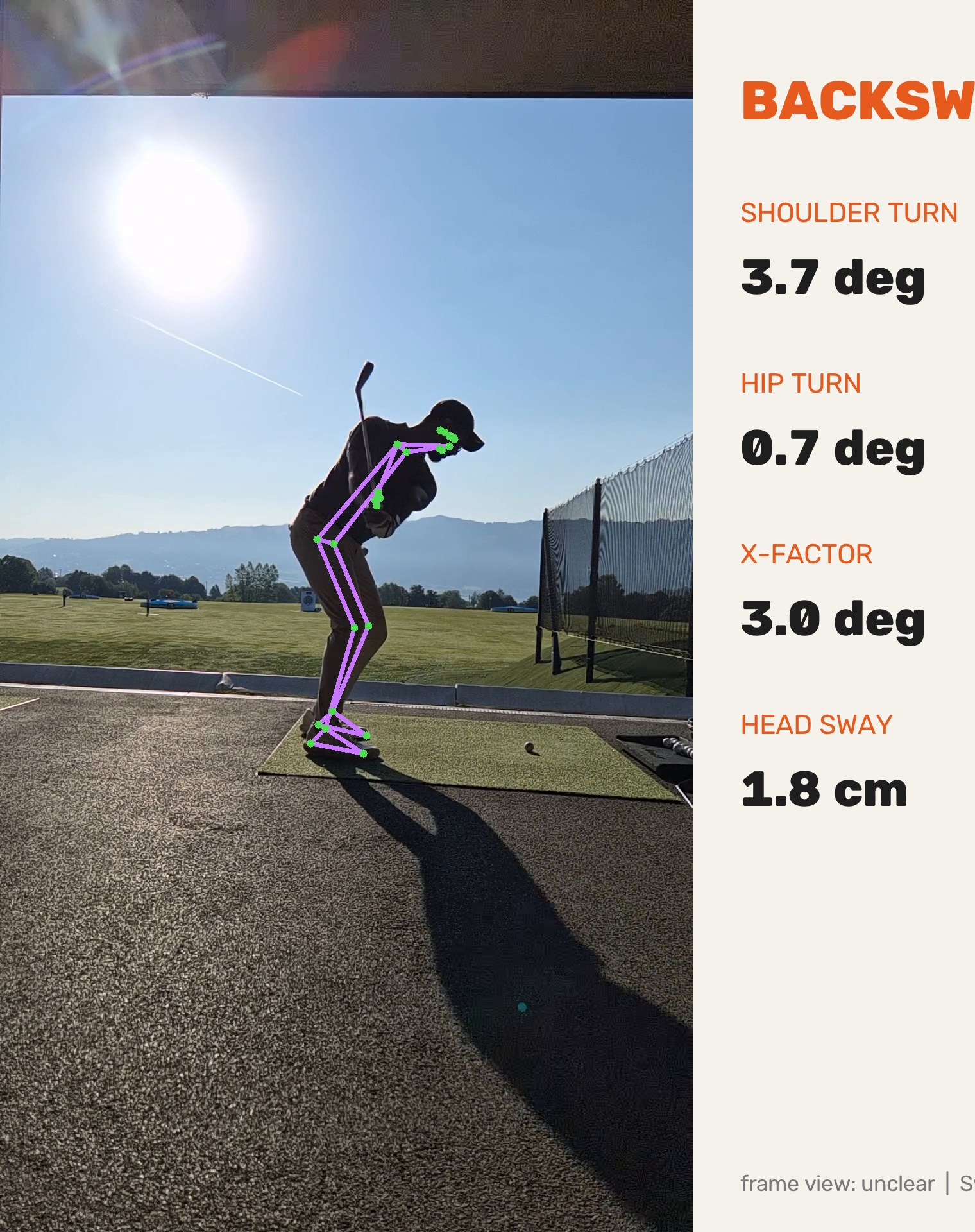
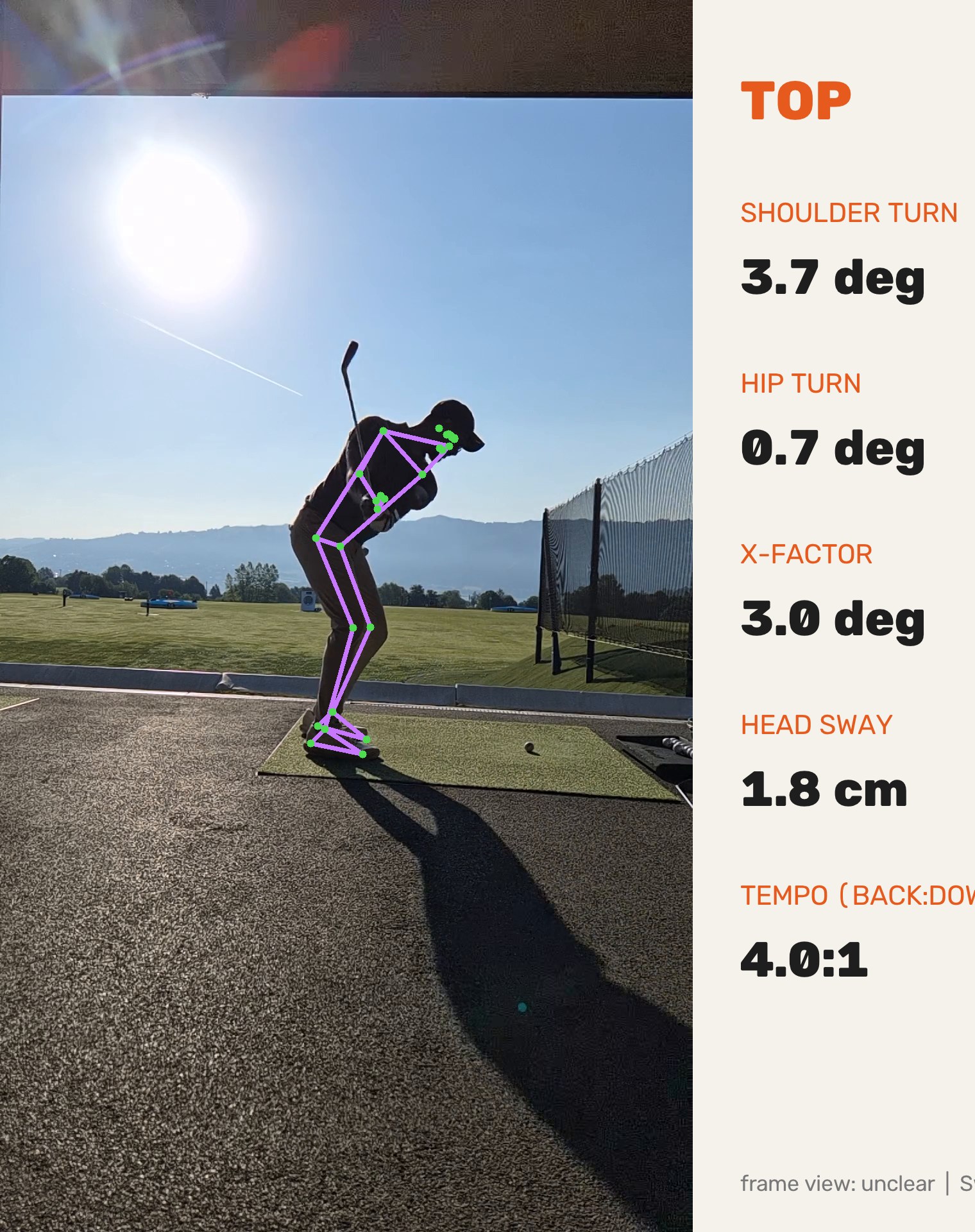
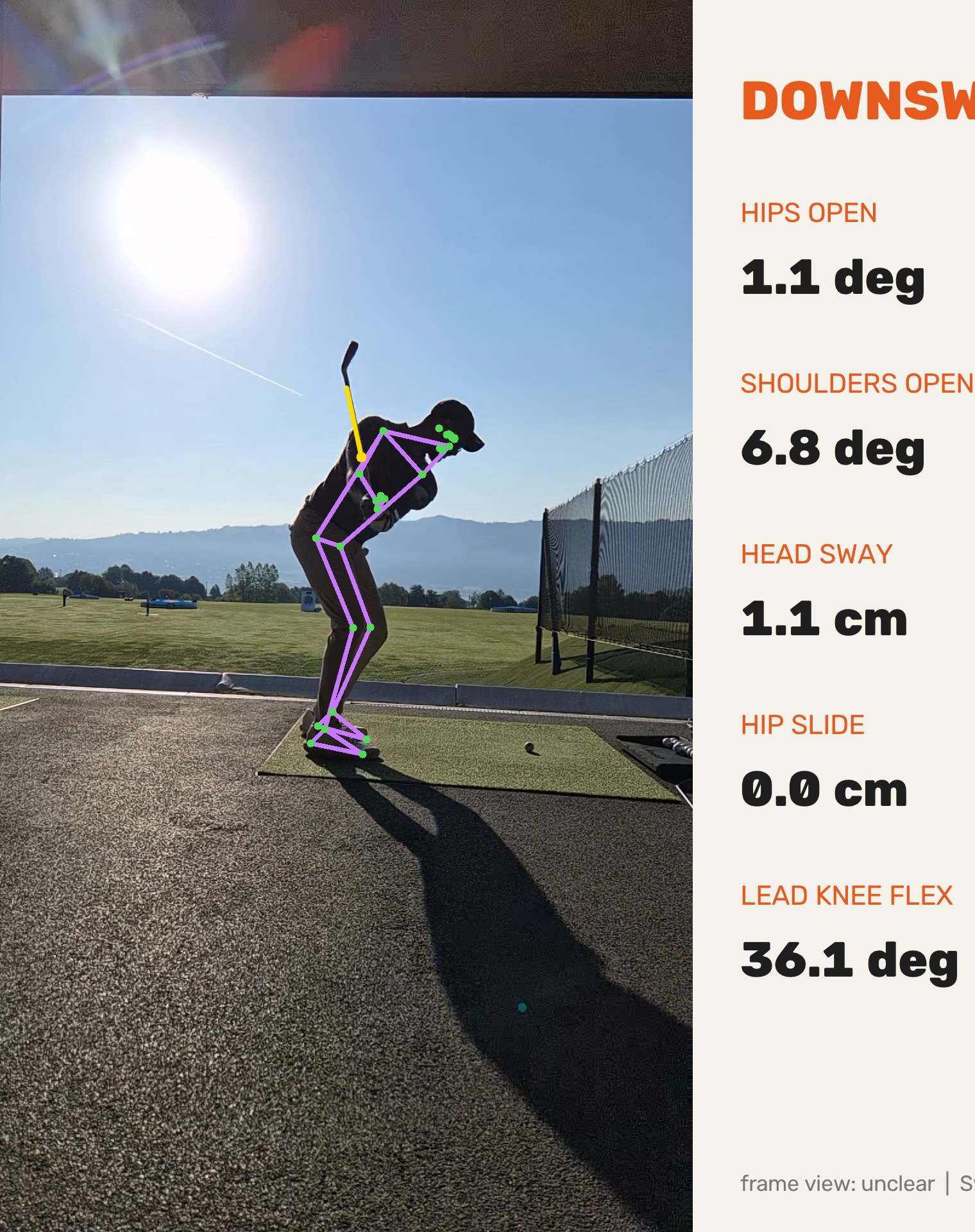
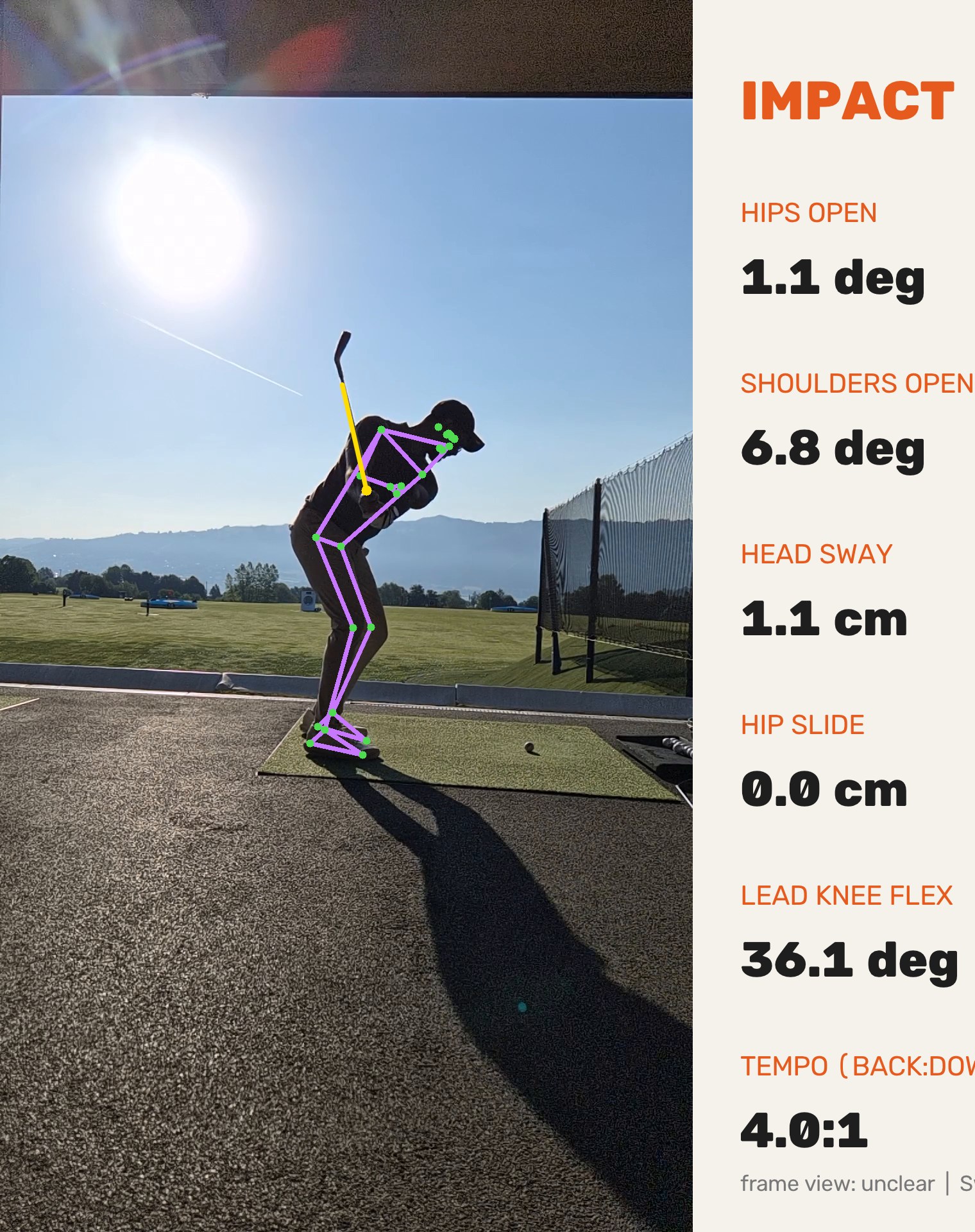
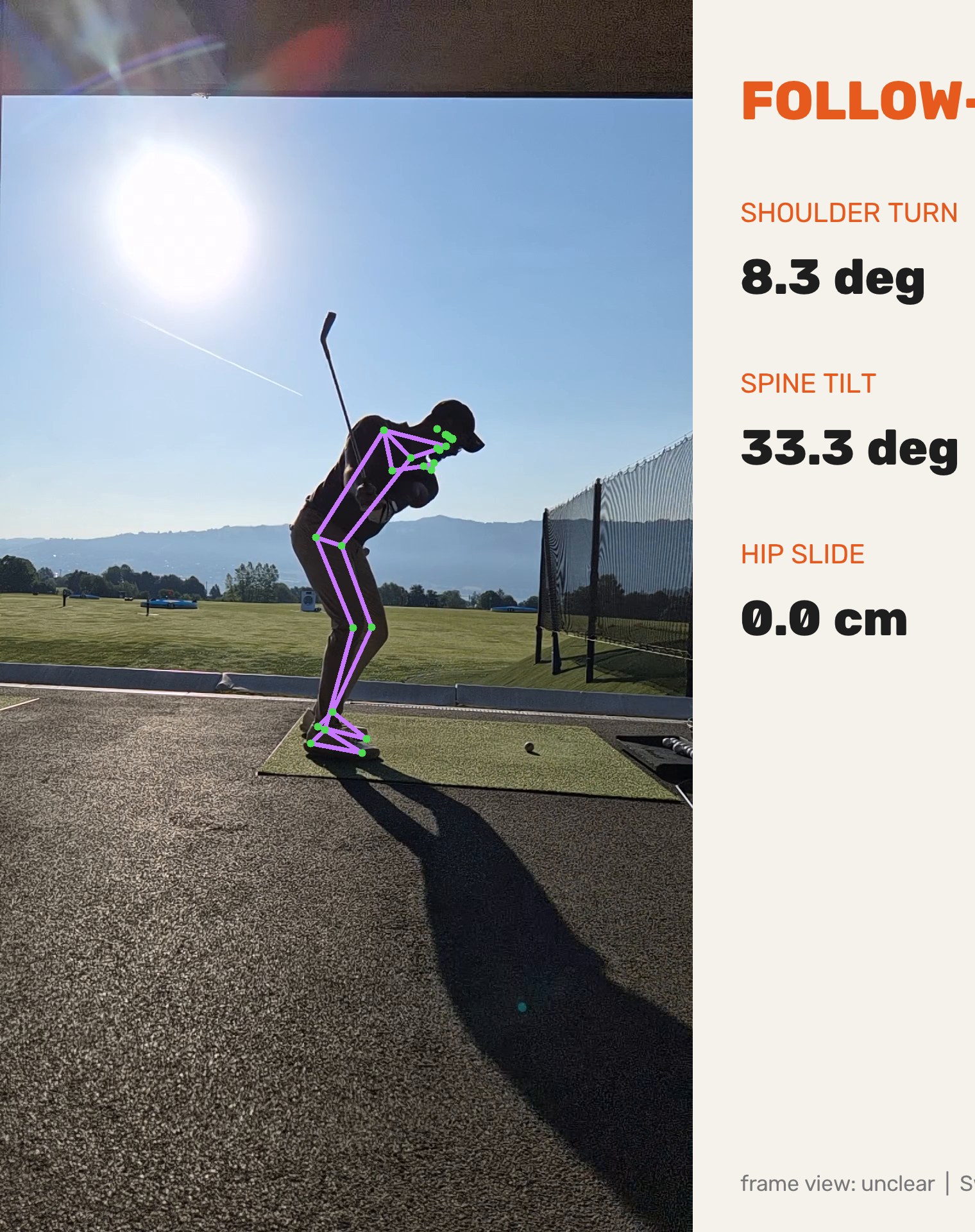
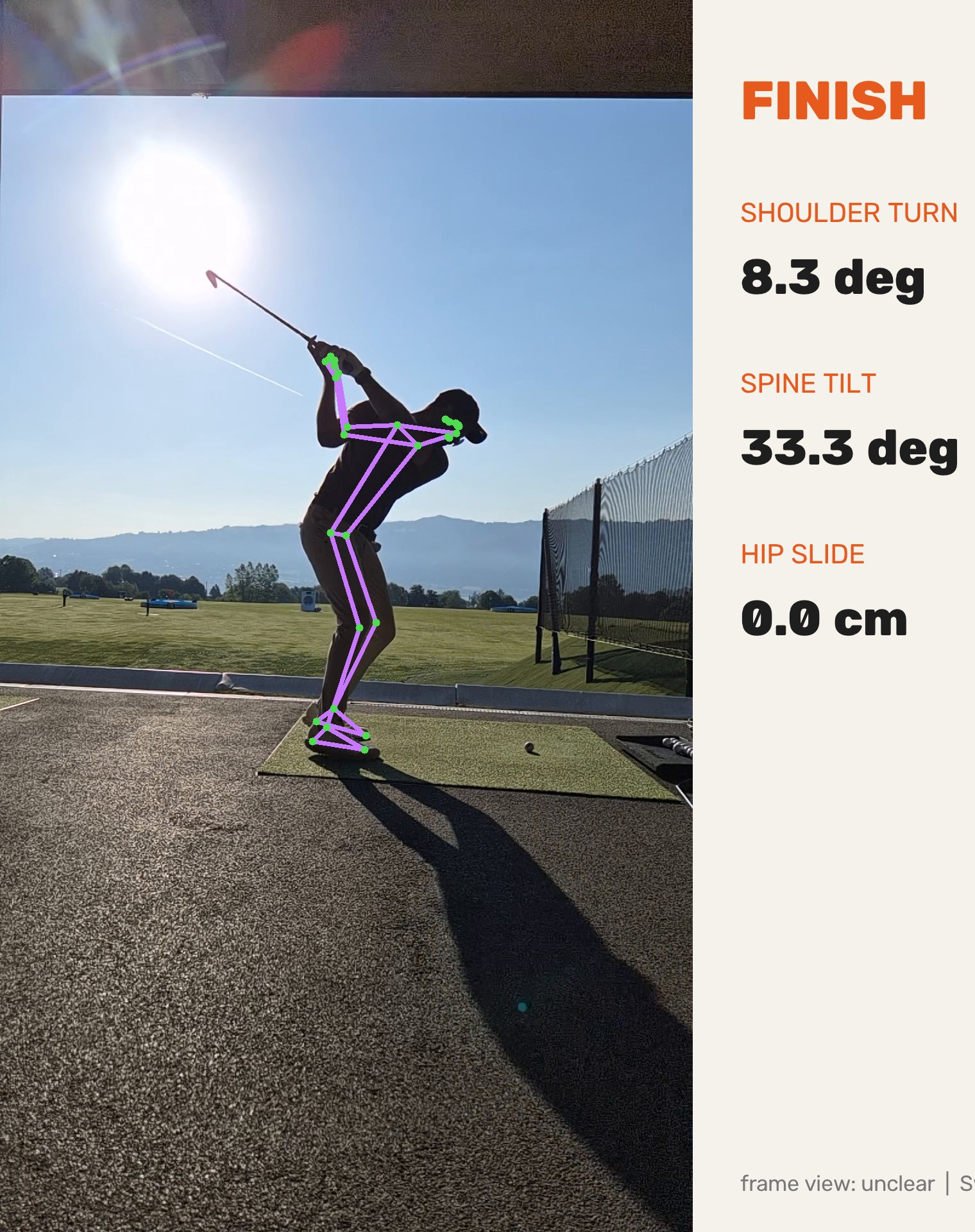
You're filmed from the front (I can see the bill of your cap and beard, and the target/ball is to your lead side on the right), so this is a face-on view. It's heavily backlit into the sun, so you're a near-total silhouette — I can read your body outline, spine angle, weight and balance well, but grip details and exact face/shaft positions are hard to see. Face-on is great for checking sway, weight shift and finish balance; for club path and true shoulder-turn depth a down-the-line angle (camera behind you looking toward the range) would add a lot. Try to film with the sun behind the camera next time.
Top 3 Priorities
Make a real shoulder turn — rotate your torso instead of lifting your arms
Your shoulder turn measured ~3.7°, essentially the same as your last session and down from ~14° earlier — the body simply isn't rotating, which is the root cause of your lack of power and contact. The goal for a beginner is 80-90° of shoulder turn so your back points toward the target at the top.
▸ Cross-arm turn drill
Set up in your golf posture with arms crossed over your chest, hands on opposite shoulders. Without lifting anything, turn your chest so your lead shoulder points down at the ball and your back turns toward the target, then turn all the way through to face the target. Feel that your shoulders are what create the motion — do 15 slow reps before each session.
▸ Club-across-shoulders coil
Hold a club across the back of your shoulders in your setup posture. Turn back until the club shaft points at the ground behind the ball, keeping your lower body relatively quiet so you feel a stretch in your torso. This teaches you what a real coil feels like versus an arm lift.
Rotate through to a full, balanced finish (clear the hips)
At impact your hips are only ~1° open and your finish shoulder turn is ~8° — you never rotate through the ball. Clearing the hips and turning to face the target is where speed and solid contact come from.
▸ Belt-buckle-to-target drill
Make slow half-swings and consciously turn your belt buckle to point at the target at the finish, ending with your weight on your lead foot and trail heel up. Hold the finish for three seconds each time. The feeling is 'turn my belt to the target,' not 'swing my arms.'
▸ Step-through drill
Hit soft shots where, just after impact, you let your trail foot step toward the target. This forces your body to rotate and your weight to move forward, killing the static, arms-only motion.
Stand a touch taller at address to free up rotation
Your rounded upper back physically blocks the shoulders from turning. Spine tilt is fine (~39°), but flattening the hunch lets the coil in Priority 1 actually happen.
▸ Tall-then-hinge setup
Stand tall with your chest lifted, then bow forward from the hips (not the waist) keeping your back flat, letting your arms hang. Feel your shoulder blades set back and down. Check that your back looks like a straight tabletop, not a rounded 'C', before every swing.
Phase Breakdown
Setup5.0
Observed: Spine tilt measured ~39°, which is inside the healthy 15-45° window, and you have real knee flex (lead ~37°, trail ~28°). However your upper back looks quite rounded/hunched rather than a tall, hinged athletic posture — the chest is collapsed over the ball.
Good: Good hip hinge and knee flex give you a solid, grounded base, and your spine tilt number is right where it should be for a 7-iron.
Improve: Flatten the rounded upper back — stick your chest out and hinge more from the hips so your shoulders can turn freely. A hunched back physically blocks rotation, which ties directly into your #1 issue.
Takeaway3.0
Observed: By the takeaway frame the shaft is already lifting toward vertical while your body stays completely still. The club is being picked up with the hands/wrists rather than moved back by a turning chest.
Good: Your head and lower body are rock-steady — no lurching or sway at the start.
Improve: Start the club back by turning your shoulders and letting the arms, hands and club move together as one unit for the first foot or two. Right now the wrists hinge and the arms lift immediately, which sets up an all-arms swing.
Backswing3.0
Observed: This is the heart of the problem: measured shoulder turn at the top is only ~3.7° and hip turn ~0.7° — essentially zero body rotation. The club goes almost straight up while your torso stays square to the ball. Head sway is a tiny 1.8 cm.
Good: Excellent stability — your head barely moves (1.8 cm) and you keep your posture, which is a great foundation once we add turn.
Improve: You need a real shoulder turn — aim to rotate your back toward the target so your lead shoulder ends up under your chin (goal ~80-90°, you're at ~4°). Think 'turn, don't lift.' The power in a golf swing comes from coiling the torso, not raising the arms.
Transition3.0
Observed: With no coil (X-factor measured ~3° vs a 25-55° target) there's nothing to unwind, so the lower body has nothing to initiate. Tempo read 4.0 but the clip had 3 swings with very noisy timing (2.03±1.97), so I wouldn't trust that number.
Good: You stay balanced and centered into the change of direction.
Improve: Once you create a genuine turn, feel the transition start from the ground — a small pressure into the lead foot and a turn of the hips before the arms come down. Can't build lag or sequence without first building the backswing turn.
Downswing3.0
Observed: The mid-downswing frame looks almost identical to the top — the body hasn't rotated, so the arms simply lower the club back down the same steep track it went up. Hard to judge true path from a backlit face-on angle.
Good: Head stays behind the ball and steady, and you're not casting violently or losing balance.
Improve: Rotate your hips and chest open toward the target as the club comes down, rather than dropping the arms with a static body. Body rotation is what shallows the club and delivers speed.
Impact3.0
Observed: At impact hips are only ~1.1° open and shoulders ~6.8° open — you're essentially square to the ball with no rotation, and hip slide is ~0 cm. Ideally your hips would be 30-40° open and weight moving forward.
Good: Your head is stable (~1.1 cm) and you stay in your posture through the ball.
Improve: Get your hips and belt buckle rotating open toward the target through impact. A square, non-rotating body at impact leads to weak, scoopy contact and inconsistent strikes with an iron.
Follow-through4.0
Observed: The finish frame shows your arms extended high overhead, but the body still hasn't rotated — measured finish shoulder turn is only ~8.3° (goal 75°+). So it's an arm-lift finish, not a rotational one, though you do stay reasonably balanced.
Good: You hold your balance and get the arms fully extended up — the framework of a finish is there.
Improve: Turn your chest and belt buckle to face the target with your weight stacked over the lead foot. A full, rotated finish is the single best sign the whole swing sequenced correctly.
Club Notes
With a 7-iron you want ball-first contact, which requires your body to rotate through and your weight to move forward so the low point is slightly ahead of the ball. The current lift-and-drop, no-rotation motion tends to produce thin or scoopy contact because the hands try to add loft the club should already provide. Ball position around center of stance is fine; the fix is rotation, not ball position.
From Coach AI
Here's the good news: the hardest-to-teach fundamentals — staying balanced and keeping your head dead steady (just 1.8 cm of sway!) — you already own. That stability is exactly what many beginners lack. You're not fighting a moving head or a loss of balance; you're just missing rotation, and rotation is a very trainable skill. Commit to the no-club turn drills for two weeks and you'll feel the difference immediately — more effortless distance and crisper strikes will follow fast once your body starts doing the work your arms are currently doing.
Notes
No notes yet. Tap Add to write one.
Launch Monitor
Add TrackMan / Garmin / Mevo numbers from your shot to ground the coaching in what the ball actually did — then Reanalyze.
Ask the Coach
Ask a follow-up question about this swing — e.g., “why is my backswing scored low?” or “what should I feel during the transition?”