Overall
4.0
/ 10
7-Iron
Jul 4, 2026, 8:18 PM
Camera: face-on (suboptimal)
Your balance and stability are genuinely good — you stay centered over the ball with almost no sway. But the swing is still almost entirely arms with virtually no body rotation: measured shoulder turn ~3.7° and X-factor ~3° are far below the beginner targets (80-105° and 25-55°). Until your torso turns, power and consistent contact will be very hard to find. Note the analysis was noisy because the clip had 3 swings and heavy backlighting.
Since Last Session
Last session your #1 priority was 'make a real shoulder turn — rotate your torso instead of lifting your arms.' The numbers are essentially unchanged: shoulder turn ~3.7° both times, X-factor ~3° both times. So the turn hasn't grown yet — but don't be discouraged, this is the hardest single change in golf and the clip's backlighting plus 3-swing jumble made this a tough one to measure cleanly. We're keeping shoulder turn as priority #1 and doubling down on the no-club chest-turn drill so the feeling becomes automatic. Your rotation-to-finish (priority #2) did show a hint of life in the final frame, which is encouraging.
3 swings detected in this clip — the clearest one was analyzed. Tempo across swings: 2.03:1 ±1.97 — lower spread means a more repeatable swing.
Swing Replay
Original recording (no overlay)
Measured Biomechanics
Measured from 3D pose estimation (±5° / ±2 cm). Green bands are beginner reference ranges for a full iron swing, not absolutes.
Key Frames
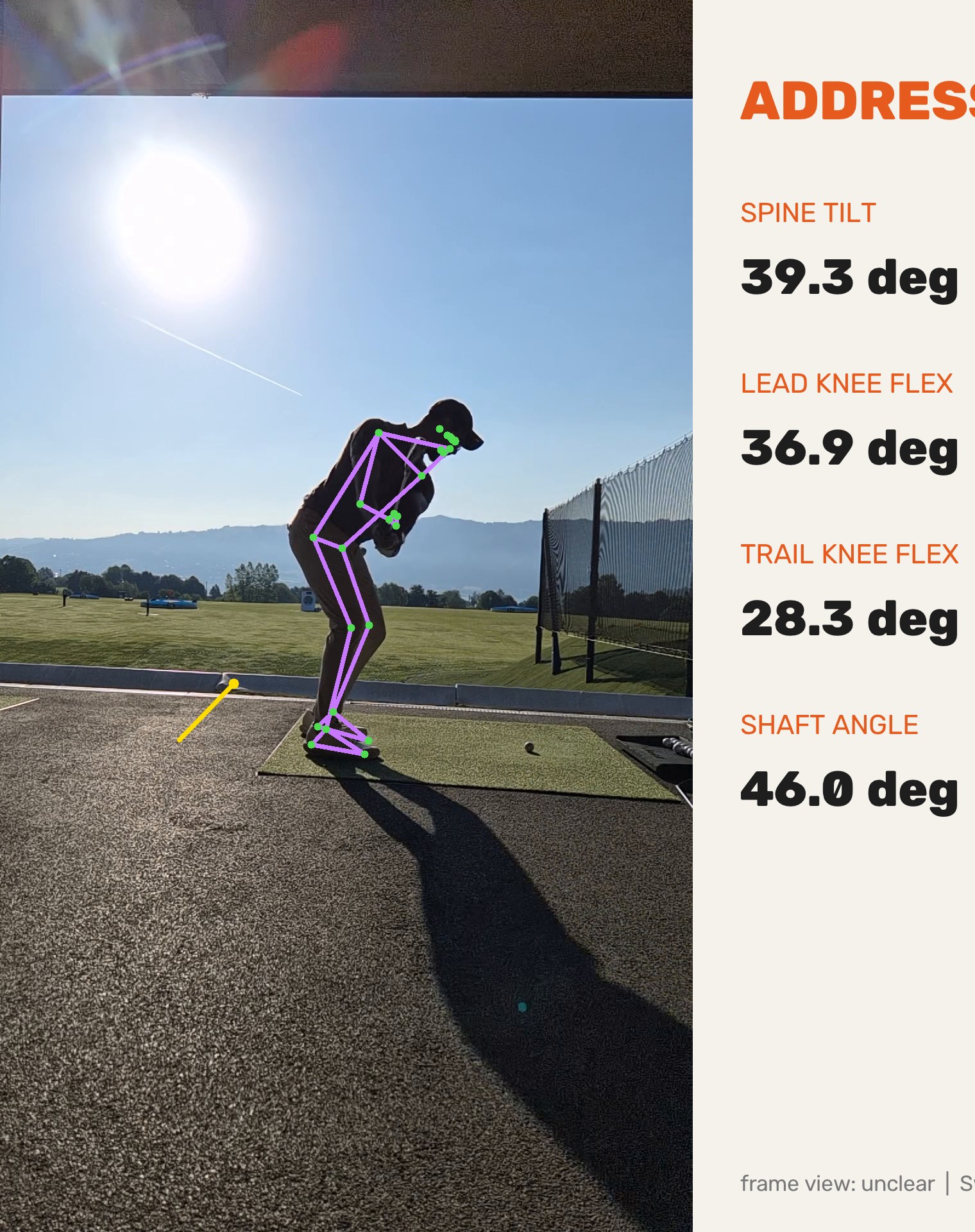
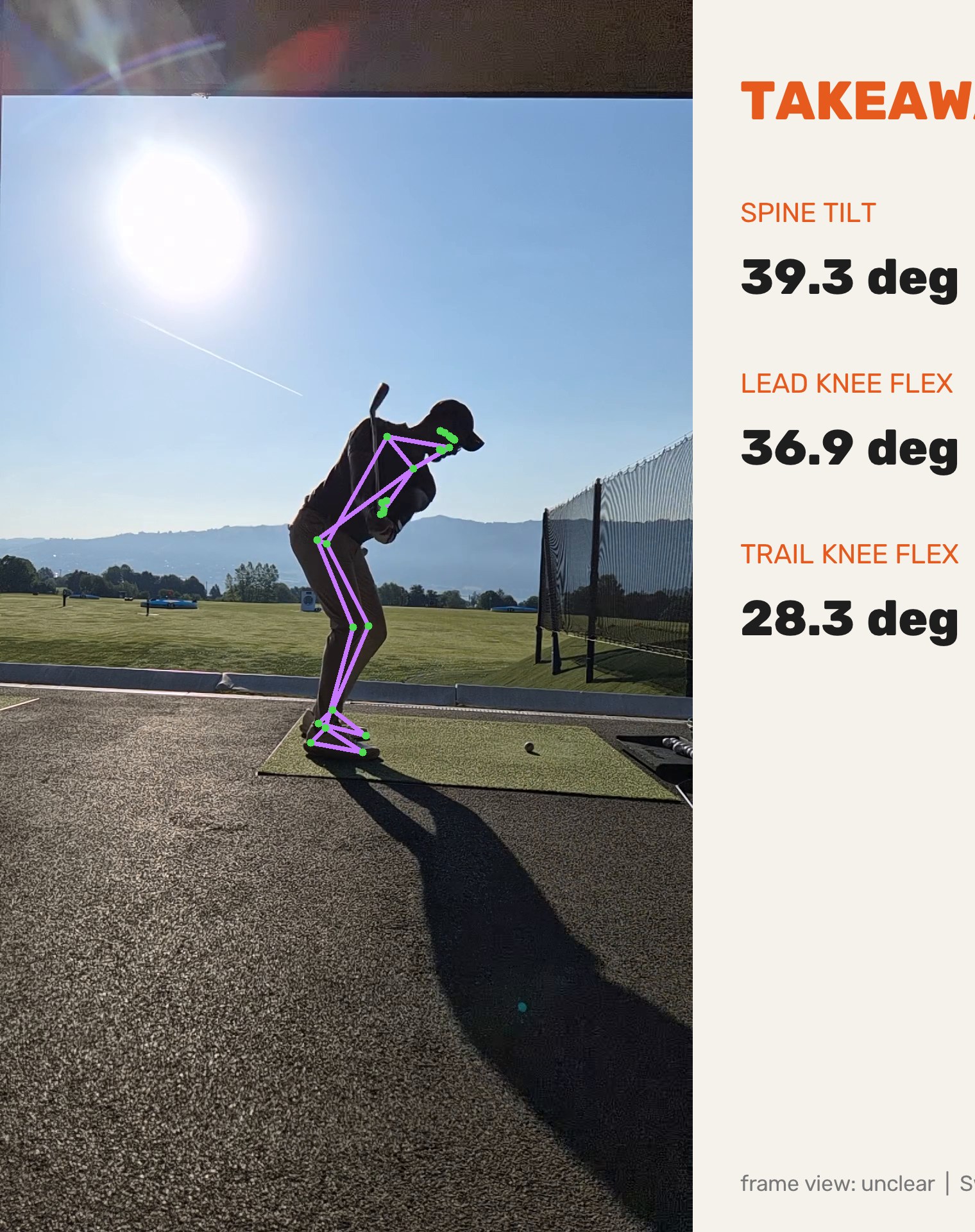
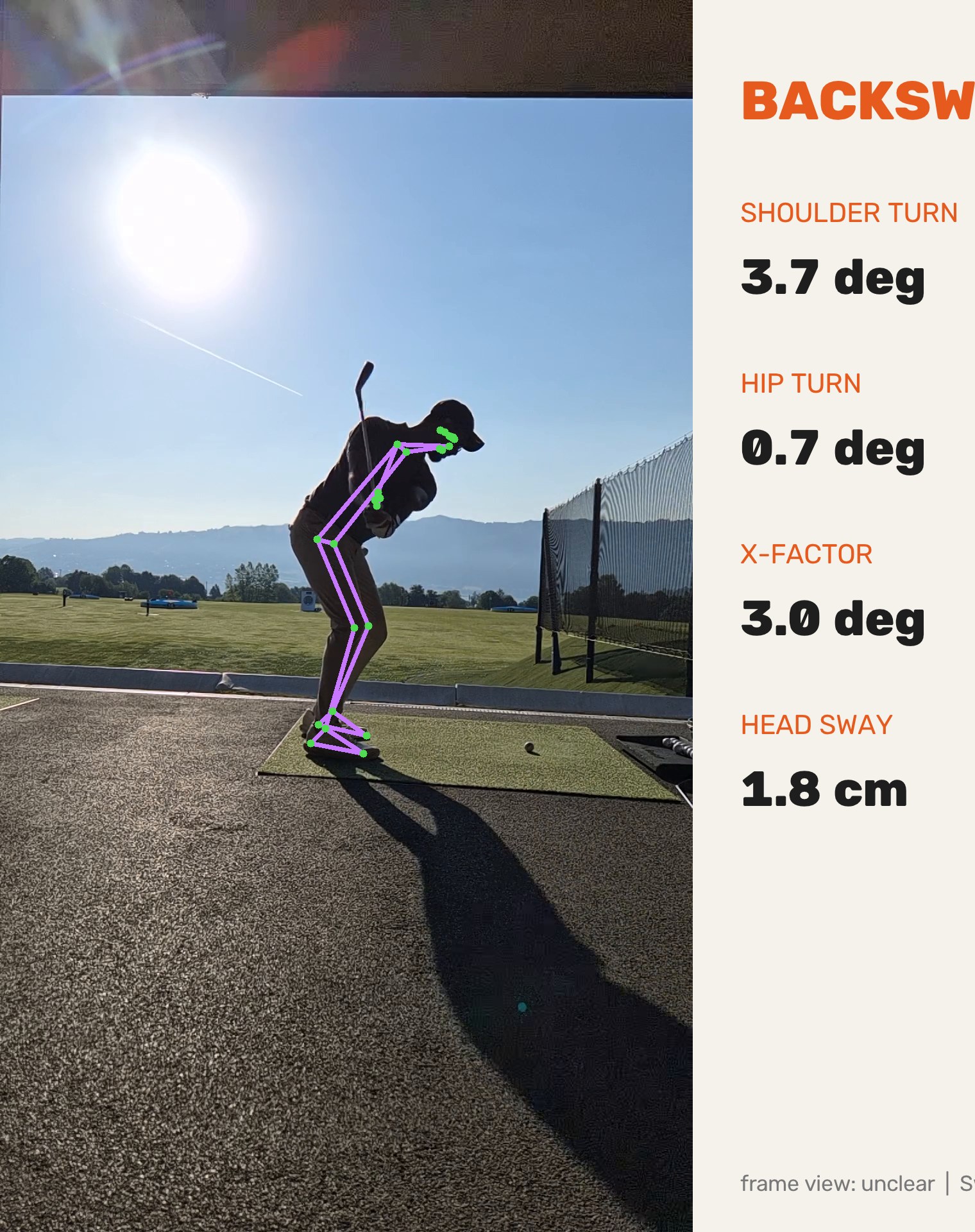
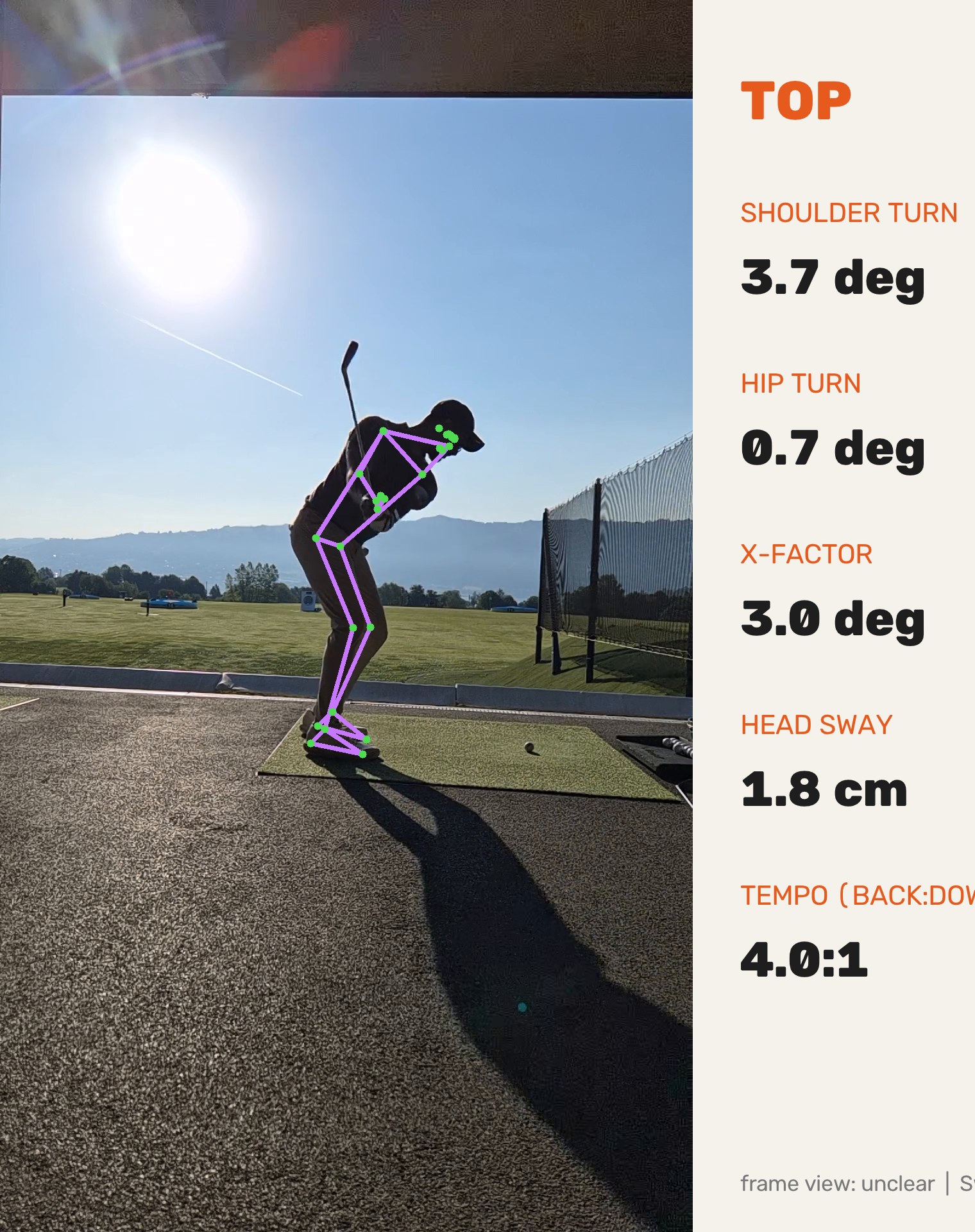
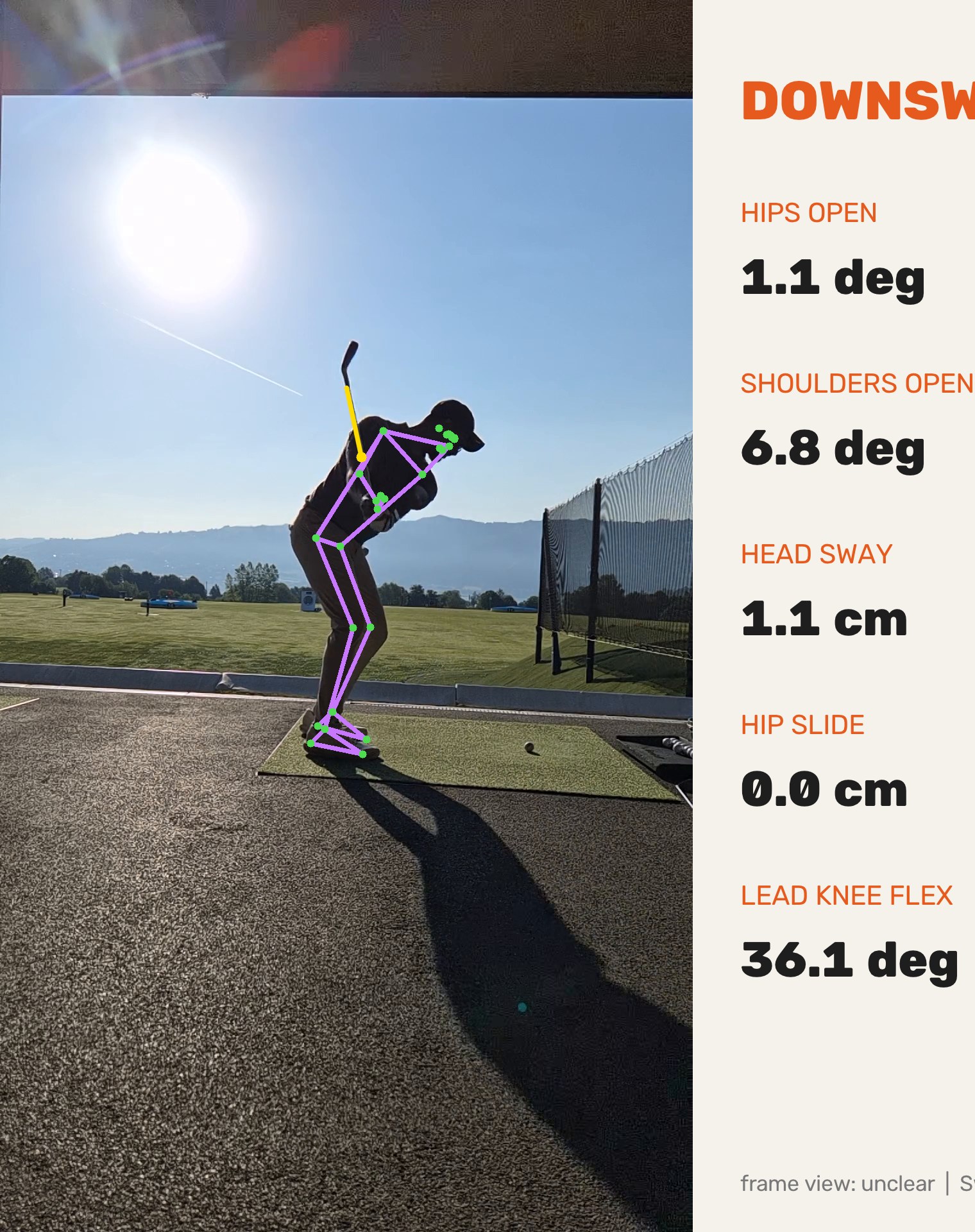
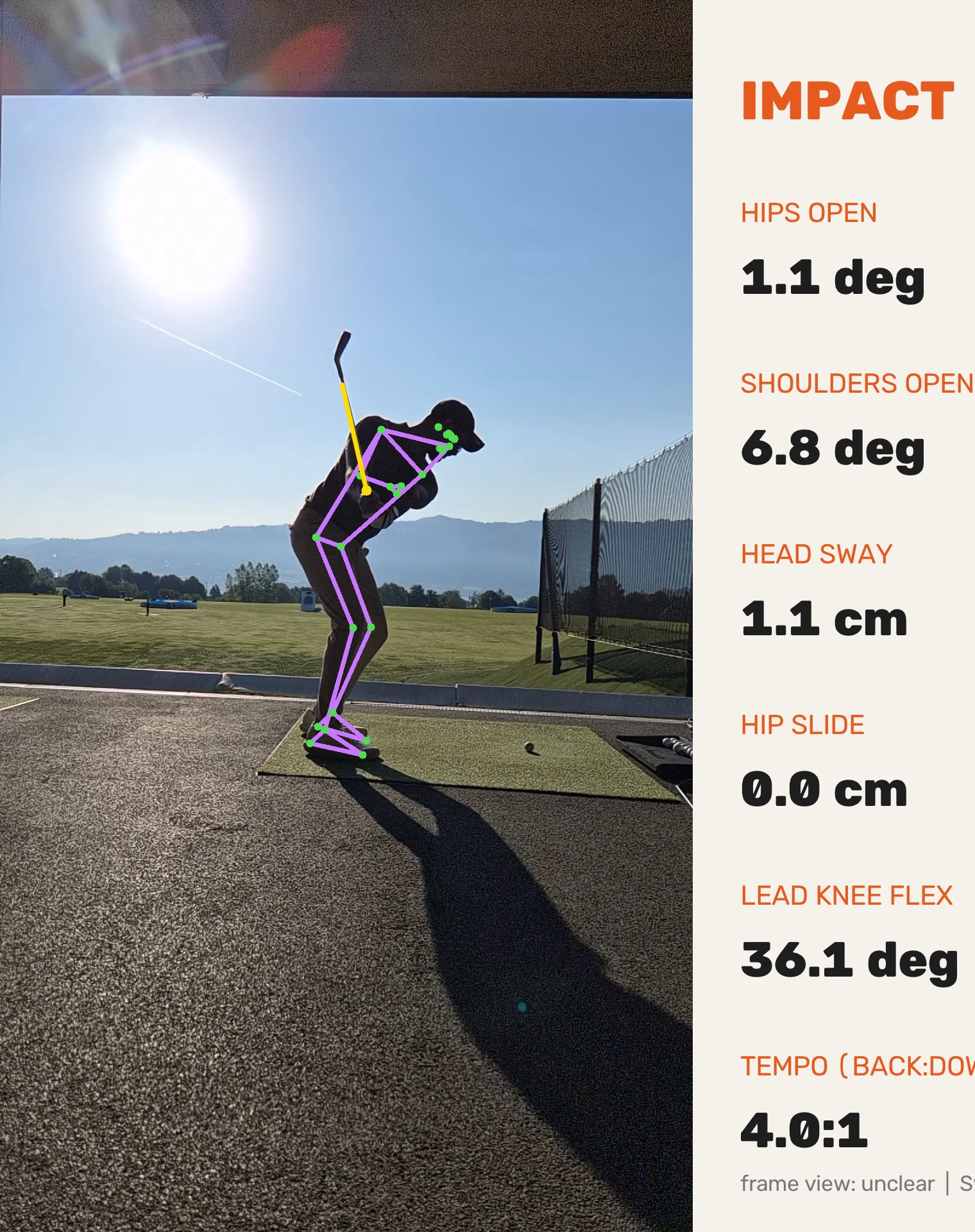
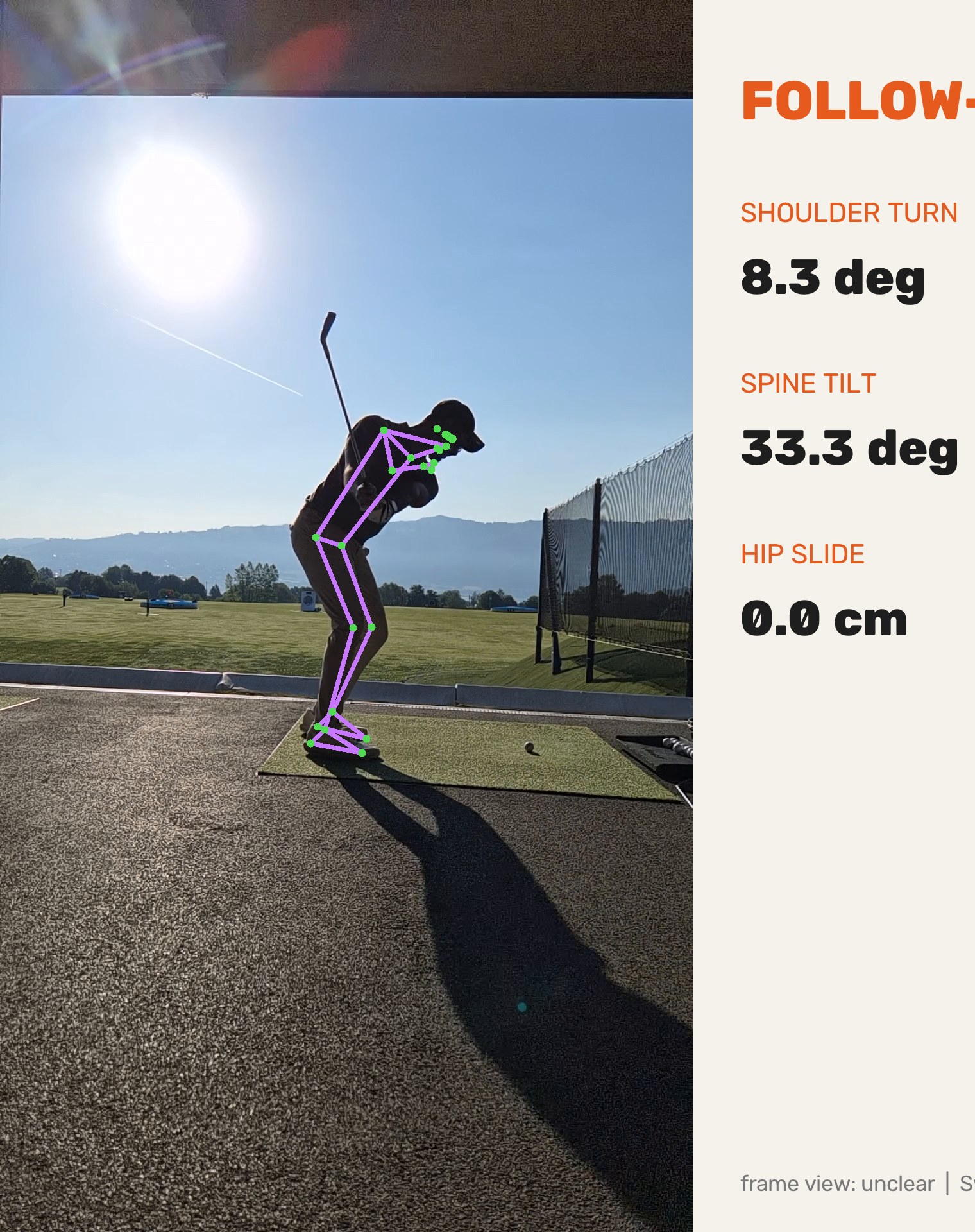
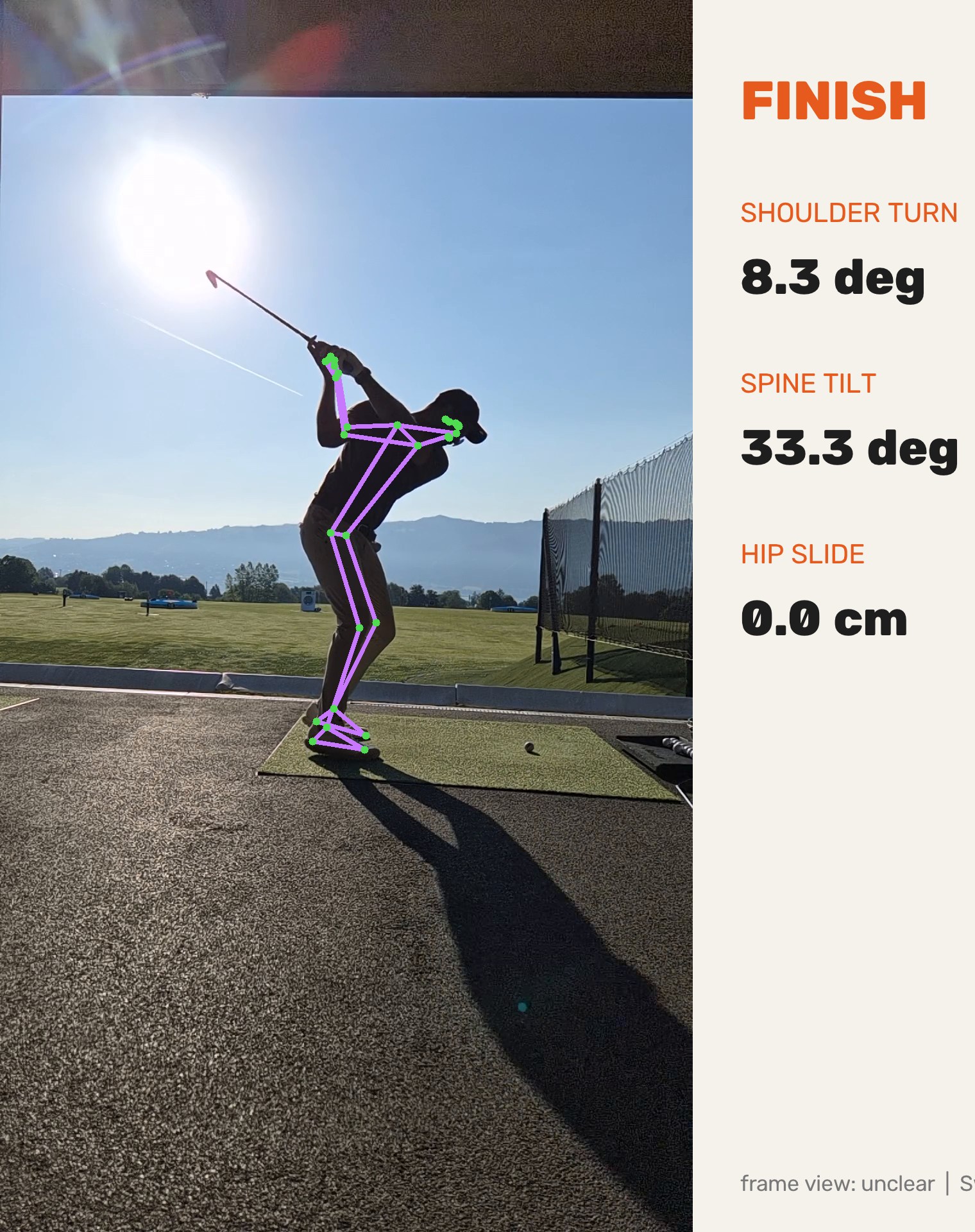
You're heavily backlit by the sun, so you appear as a silhouette — this hides grip detail, clubface, and exact shoulder/hip lines. The pipeline also flagged the view as 'unclear' and detected 3 swings in the clip, so several of the labeled frames (address through mid-downswing) look almost identical and are likely mislabeled. For the cleanest read, film with the sun behind the camera (not behind you), from about hip height, showing your whole body and the ball.
Top 3 Priorities
Make a real shoulder turn — turn your chest, don't just lift your arms
Your shoulder turn measured ~3.7° again this session (same as last time and target is 80-90°). This is the single biggest thing holding your swing back — with no coil there's no power source and contact stays inconsistent. Everything else improves once you turn.
▸ Cross-arm chest turn
Without a club, cross your arms over your chest and take your golf posture. Turn your lead shoulder until it points down at the ball position, feeling your back turn toward the target. Do 15 slow reps, then keep that same turning feel when you add the club — the club moves because you turned, not because you lifted.
▸ Back-to-target drill
Make slow half-speed swings with your 7-iron and pause at the top, checking that your back has rotated toward the target (or your imaginary target). Hold 2 seconds each rep. The feeling should be your whole torso coiling, not your hands going up.
Rotate through to a full, balanced finish (clear the hips)
Your hips were only ~1° open at impact and finish shoulder turn ~8° (target 75+°). Learning to keep rotating through the ball onto your lead foot is how you deliver the club with speed and get crisp iron contact.
▸ Step-through finish
Hit soft shots and after impact let your trail foot come up on its toe as your hips and chest rotate to face the target. Finish with your weight fully on your lead foot and hold it for a count of three. If you can hold it, you rotated through.
▸ Belt-buckle to target
Make practice swings focusing on driving your belt buckle to point at the target by the finish. Feel the lead hip clear out of the way so your arms have room to swing through.
Stand a touch taller at address to free up rotation
Your spine tilt measured ~39° with a rounded upper back — a hunched setup physically restricts how far your shoulders can turn. A taller, flatter-back posture unlocks the rotation you're working on in priority 1.
▸ Tall-then-hinge setup
Stand tall with the club, push your hips back and hinge forward from the hip joints (not the waist), keeping your back long and flat. Add a small knee flex. Your chest should feel proud, not slumped — this gives your shoulders freedom to turn.
Phase Breakdown
Setup5.0
Observed: Spine tilt measured ~39° from vertical, which is on the steep/hunched end of the acceptable 15-45° band. Your upper back looks rounded and you're bent quite far over the ball. Lead knee flex ~37°, trail knee ~28° — reasonable knee bend. Silhouette hides grip and ball position.
Good: You have real knee flex and a stable, balanced base — your feet are planted and weight looks centered.
Improve: Stand a touch taller and hinge more from the hips than the upper back. Flatten that rounded upper back so your chest can turn freely — a hunched setup physically locks up your shoulder turn before you even start.
Takeaway4.0
Observed: The first several frames are nearly identical, so the takeaway barely registers. The club and hands stay in front of the chest with almost no movement away from the ball — the body isn't starting the motion.
Good: Your head and lower body stay quiet and stable early on, which is a good foundation once you add real rotation.
Improve: Start the takeaway by turning your chest and shoulders away from the ball, keeping the triangle of arms and shoulders together. Feel the club move because your torso turned, not because your hands lifted.
Backswing2.0
Observed: This is the core issue: measured shoulder turn at the top was only ~3.7° and hip turn ~0.7°. That's essentially no rotation — the frames show the arms staying in front of the body with the club barely rising. Head sway a tiny 1.8 cm (good stability, but because almost nothing is moving).
Good: You stay very steady over the ball with almost no sway — the balance and centeredness are there to build on.
Improve: You need a dramatically bigger shoulder turn. Target ~80-90°: your goal is to get your lead shoulder behind the ball and your back nearly facing the target. Right now the swing is almost pure arms with no coil.
Transition3.0
Observed: With essentially no backswing turn there's little to transition from. Measured X-factor was ~3° (target 25-55°), meaning shoulders and hips are turning together as one stiff unit. Tempo read 4.0:1 but the multi-swing clip made tempo detection very noisy (2.03±1.97).
Good: You're not rushing or lunging — the motion is controlled.
Improve: Once you build a real shoulder turn, let the lower body (lead hip) start the downswing while the upper body is still coiled. That separation is where power comes from, but it can only exist after you make a genuine backswing turn.
Downswing3.0
Observed: The downswing frames again look nearly static — hands stay in front of the body, no clear sequencing or lag visible. Because there's little turn back, there's little to deliver forward.
Good: Head stays behind and steady, and you keep your posture — no early standing up.
Improve: Feel the lead hip clear (rotate open toward the target) to pull the arms down, rather than pushing with the hands from the top.
Impact3.0
Observed: Measured hips only ~1.1° open and hip slide ~0 cm at impact, versus a target of 30-60° open with weight moving forward. Your hips are square/closed and weight looks centered rather than shifted to the lead foot.
Good: Head position stays steady and behind the ball, and you maintain your spine angle — you're not flipping up.
Improve: Get your hips opening toward the target through impact and your weight onto your lead foot. Open hips clear space for the arms and are the difference between crisp iron contact and weak, scoopy strikes.
Follow-through4.0
Observed: The final frame is the best of the sequence — arms elevated and club up with some genuine rotation, more than anywhere else in the swing. But measured finish shoulder turn was only ~8.3° (target 75+°) and there's no clear weight transfer to the lead side.
Good: You do get the arms up and the club released at the end — the athletic capability to finish is clearly there.
Improve: Rotate all the way through so your chest faces the target and your weight ends stacked on your lead foot, and hold that finish for a 2-count. A full, balanced finish is the best proof you rotated instead of just swinging your arms.
Club Notes
With a 7-iron, play the ball roughly center of your stance and focus on turning through so the club strikes the ball then the ground. Crisp iron contact depends on rotating your body and shifting weight forward — the exact two things (turn and hip clearance) at the top of your priority list. The shaft-detection numbers were unreliable here given the silhouette and multiple swings, so I wouldn't read into them.
From Coach AI
Here's the good news: your balance and stability are excellent — you stay perfectly centered over the ball, which is something many beginners struggle with and it's the hardest foundation to build. That means the only missing piece is rotation, and rotation is very trainable. Commit to the cross-arm chest-turn drill this week — even 5 minutes a day — and you'll unlock power and cleaner contact you didn't know you had. You're closer than the score suggests; it's one big feel away from clicking.
Notes
No notes yet. Tap Add to write one.
Launch Monitor
Add TrackMan / Garmin / Mevo numbers from your shot to ground the coaching in what the ball actually did — then Reanalyze.
Ask the Coach
Ask a follow-up question about this swing — e.g., “why is my backswing scored low?” or “what should I feel during the transition?”