Overall
4.0
/ 10
PW
Jul 4, 2026, 7:51 PM
Camera: down-the-line (suboptimal)
You have genuinely good stability — steady head, solid posture angles, and a calm tempo — but the swing is currently an arms-only lift with almost no body rotation (shoulder turn 3.7°, hip turn 0.7°, hips 1.1° open at impact). That single missing fundamental caps the score, because rotation is where distance, consistency, and clean contact come from. Fix the turn and this jumps quickly.
Since Last Session
Your top priority last time was 'make a real shoulder turn — rotate, don't lift.' Unfortunately the numbers show it hasn't clicked yet: shoulder turn measured 3.7° this session versus 13.9° previously, and X-factor is still near zero (3°). The swing is still an arms-only lift with the body staying square to the ball, and your hips stayed 1.1° open at impact. This isn't a failure — it just means the turn feeling hasn't transferred to real swings yet, so we're keeping it as priority #1 and drilling it more deliberately with the cross-arm and back-to-target drills before adding speed.
3 swings detected in this clip — the clearest one was analyzed. Tempo across swings: 2.03:1 ±1.97 — lower spread means a more repeatable swing.
Swing Replay
Original recording (no overlay)
Measured Biomechanics
Measured from 3D pose estimation (±5° / ±2 cm). Green bands are beginner reference ranges for a full iron swing, not absolutes.
Key Frames
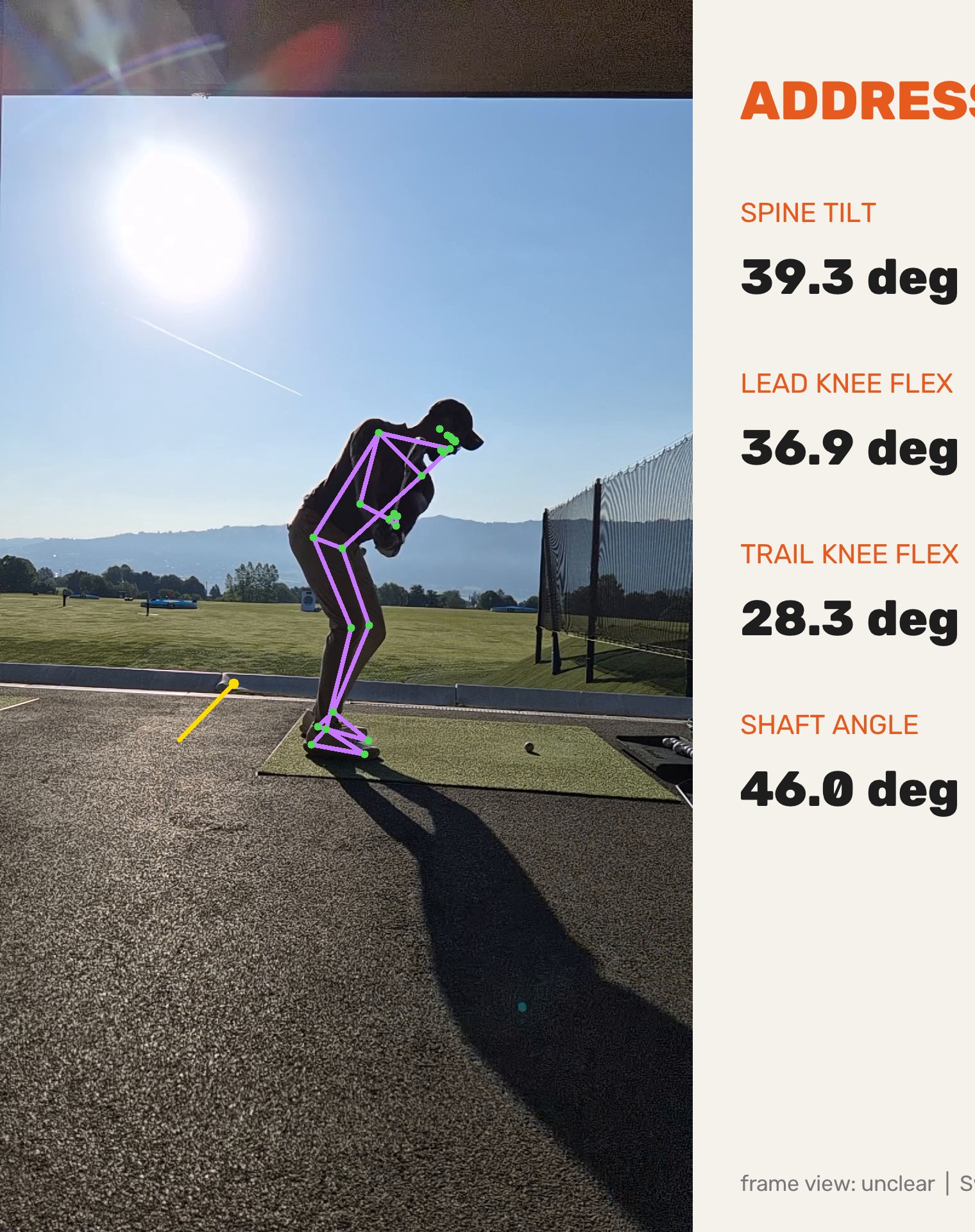
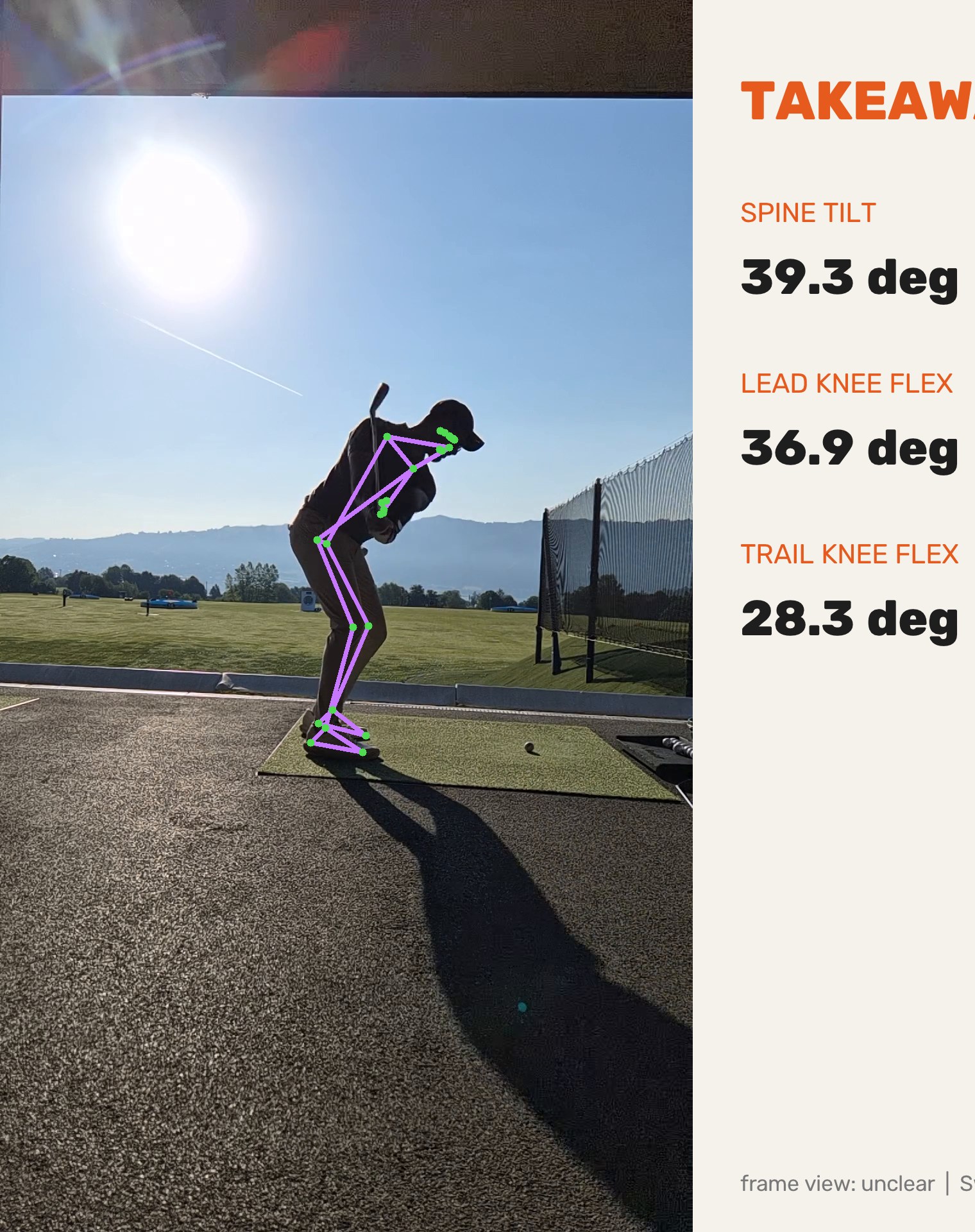
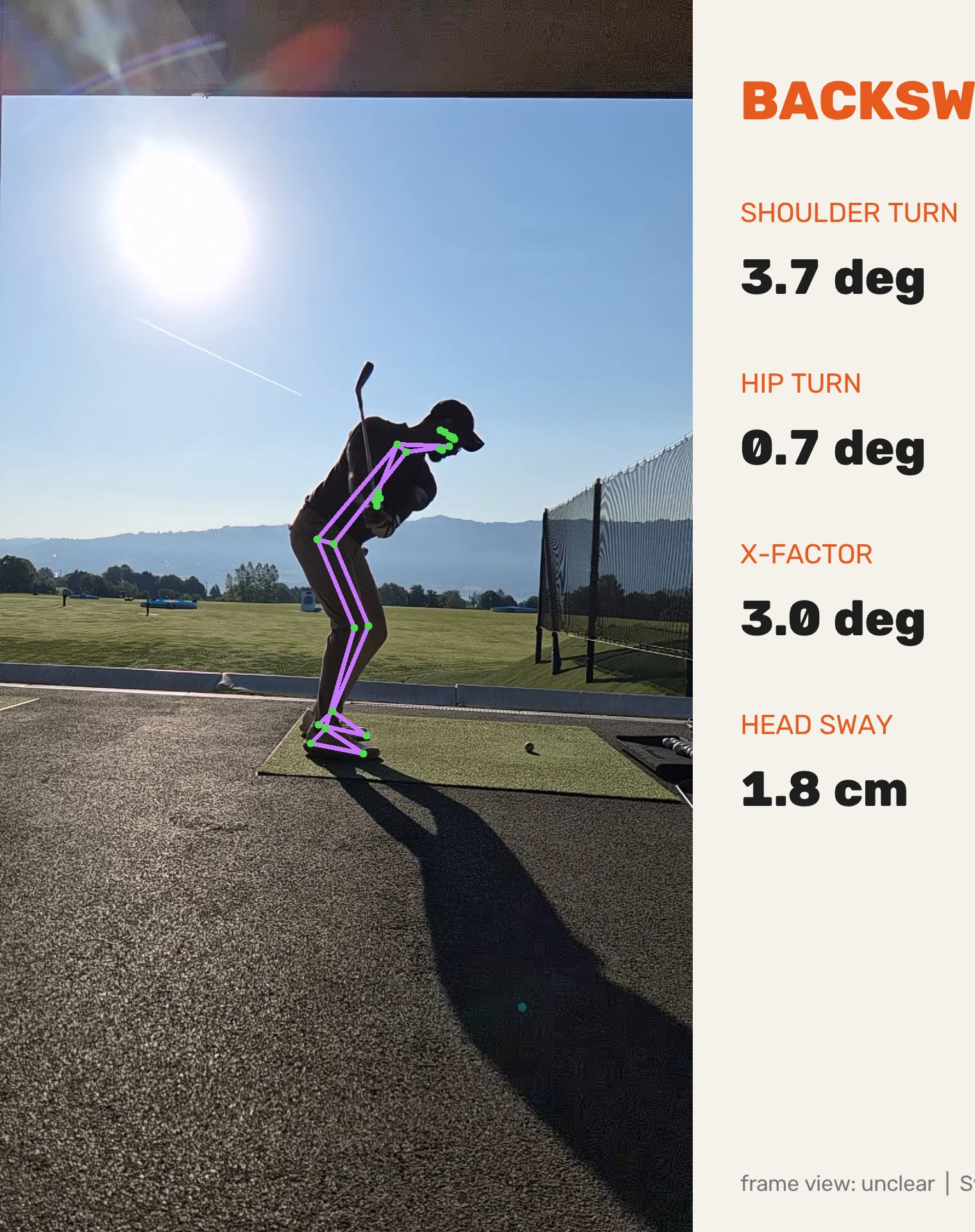
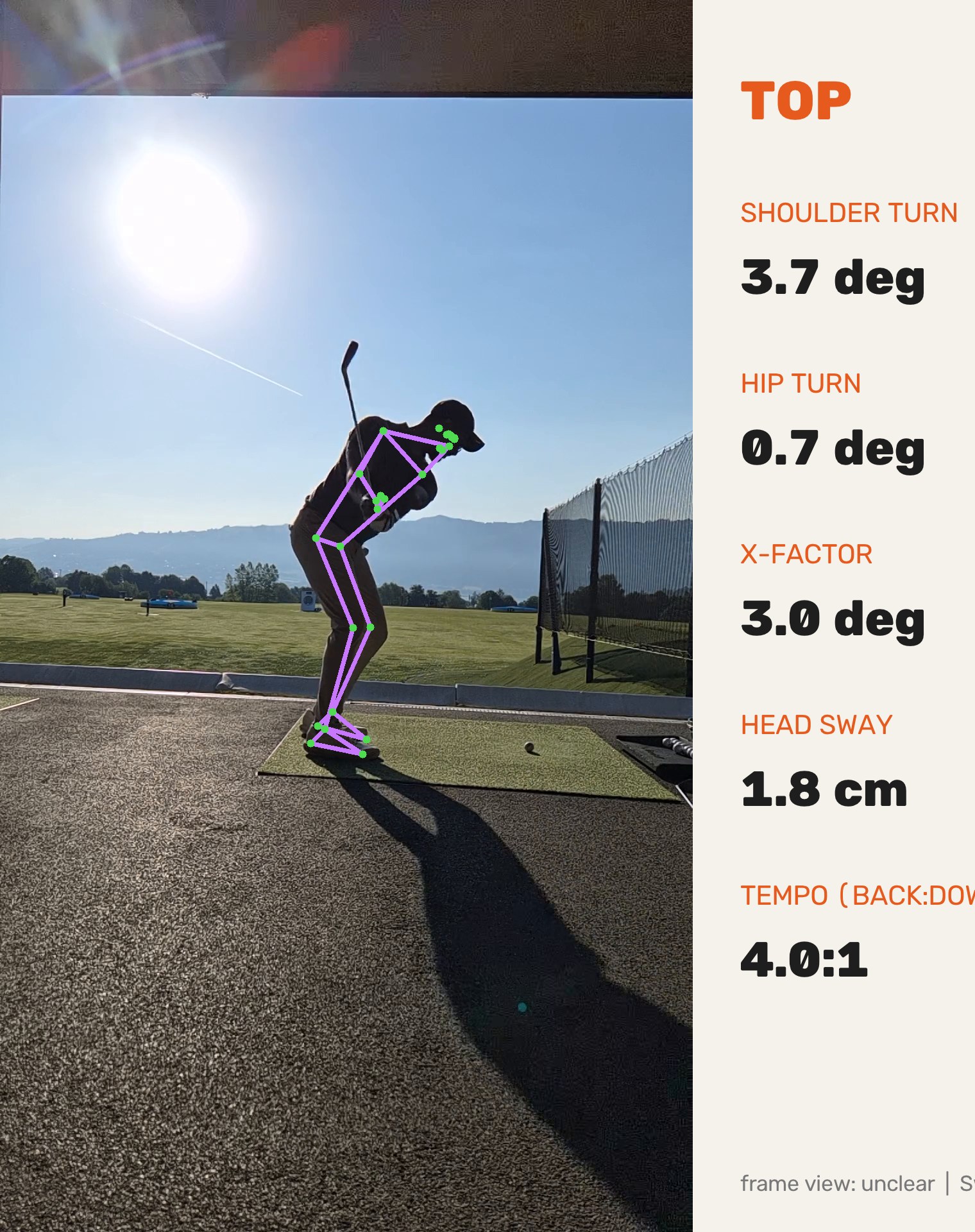
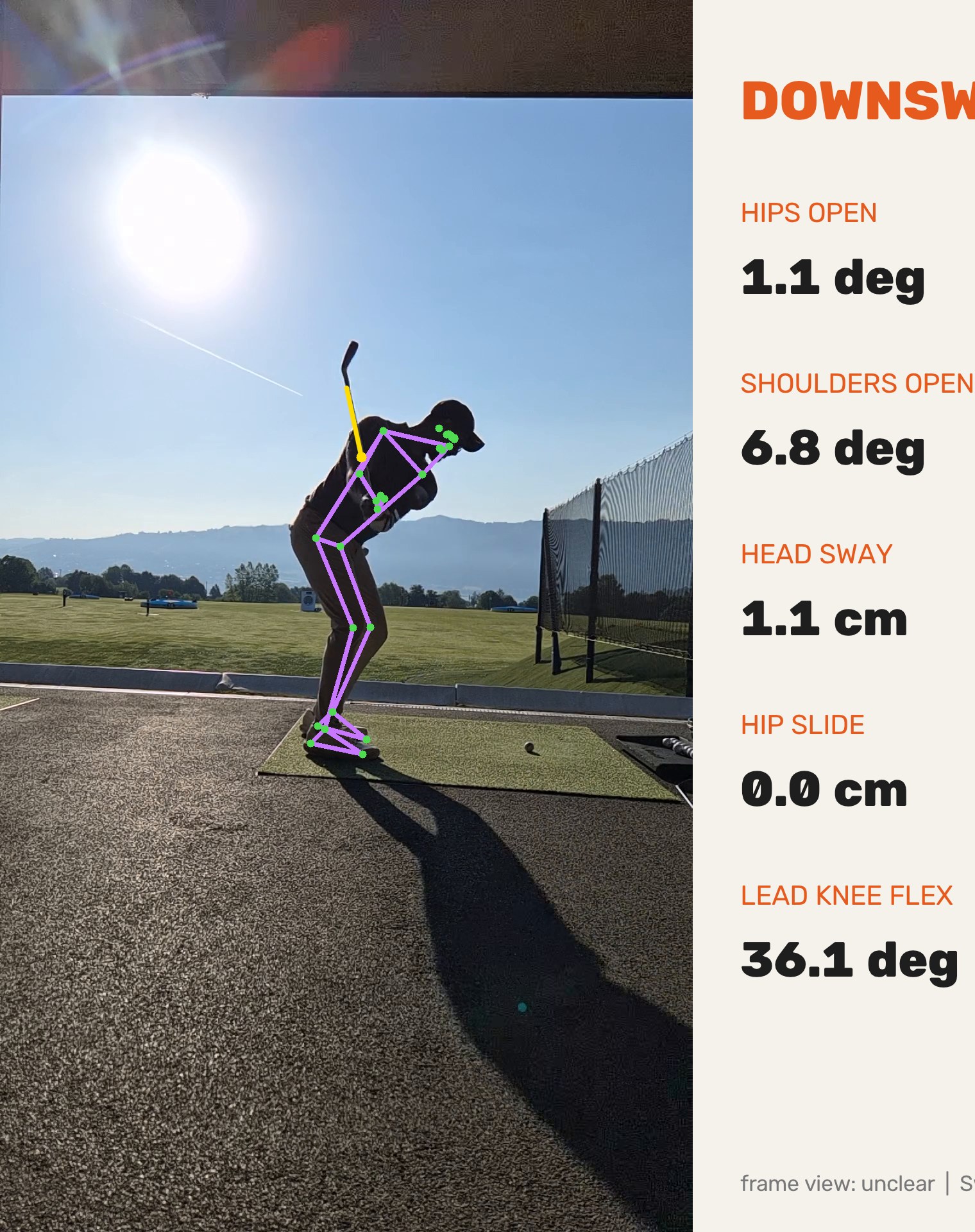
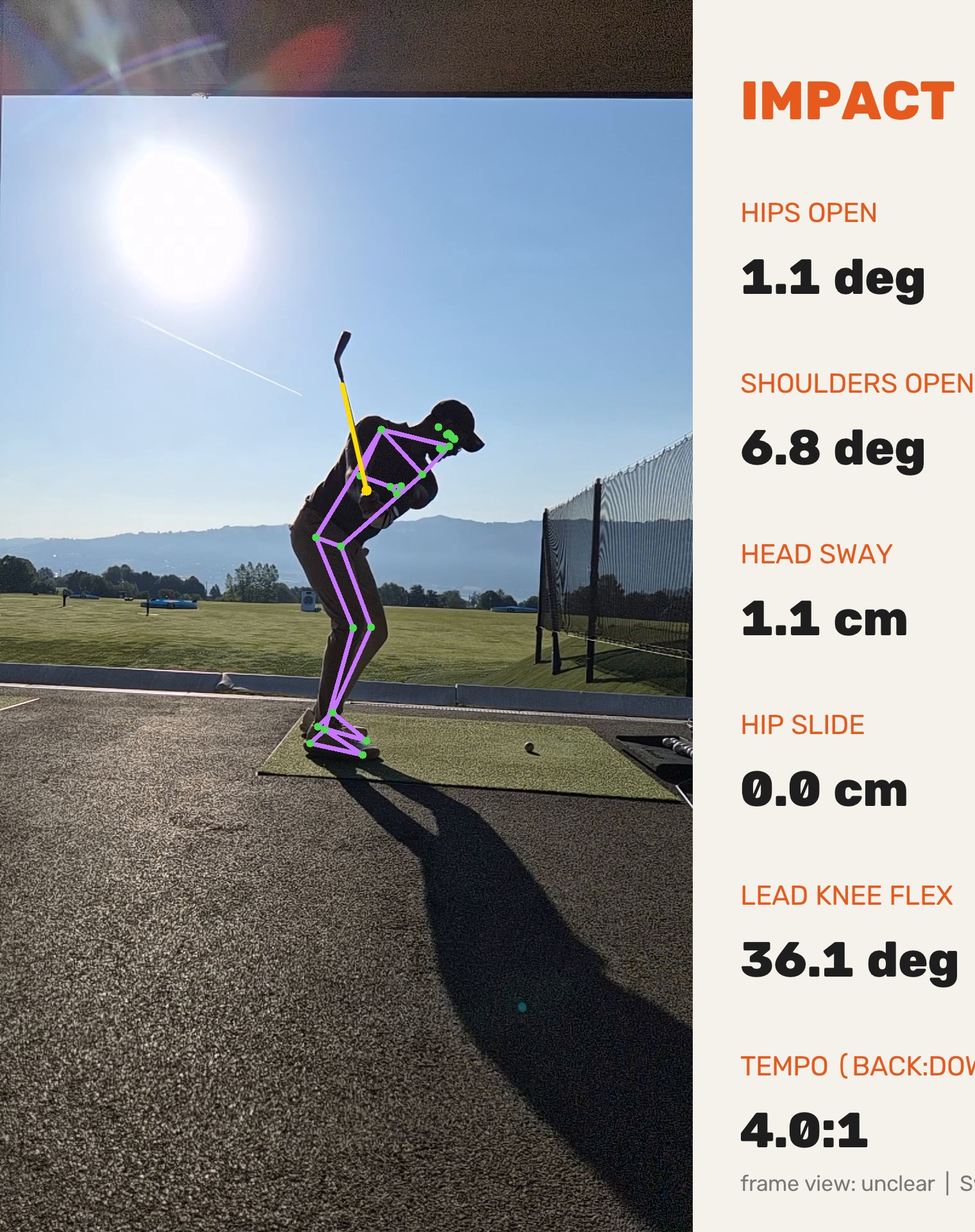
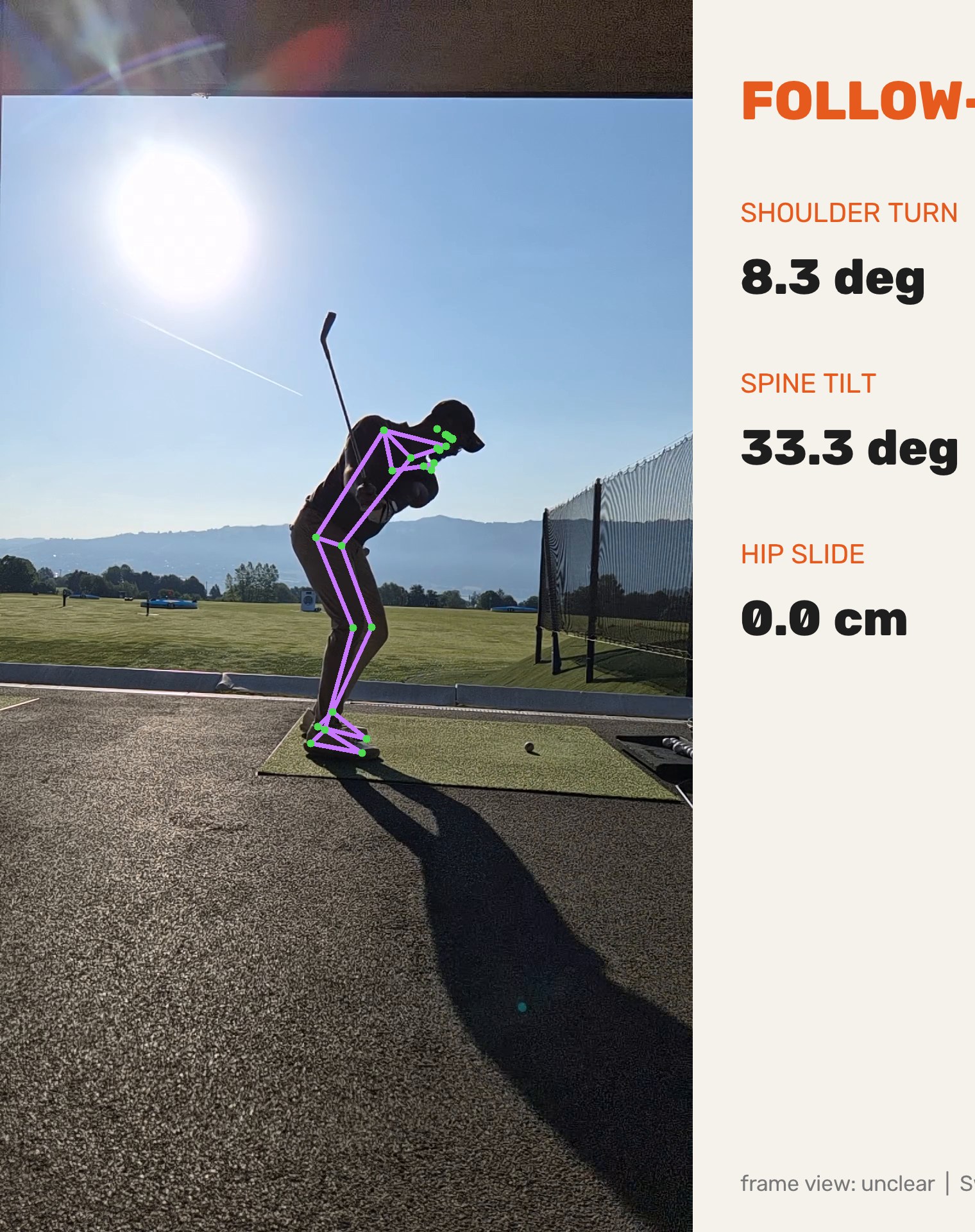
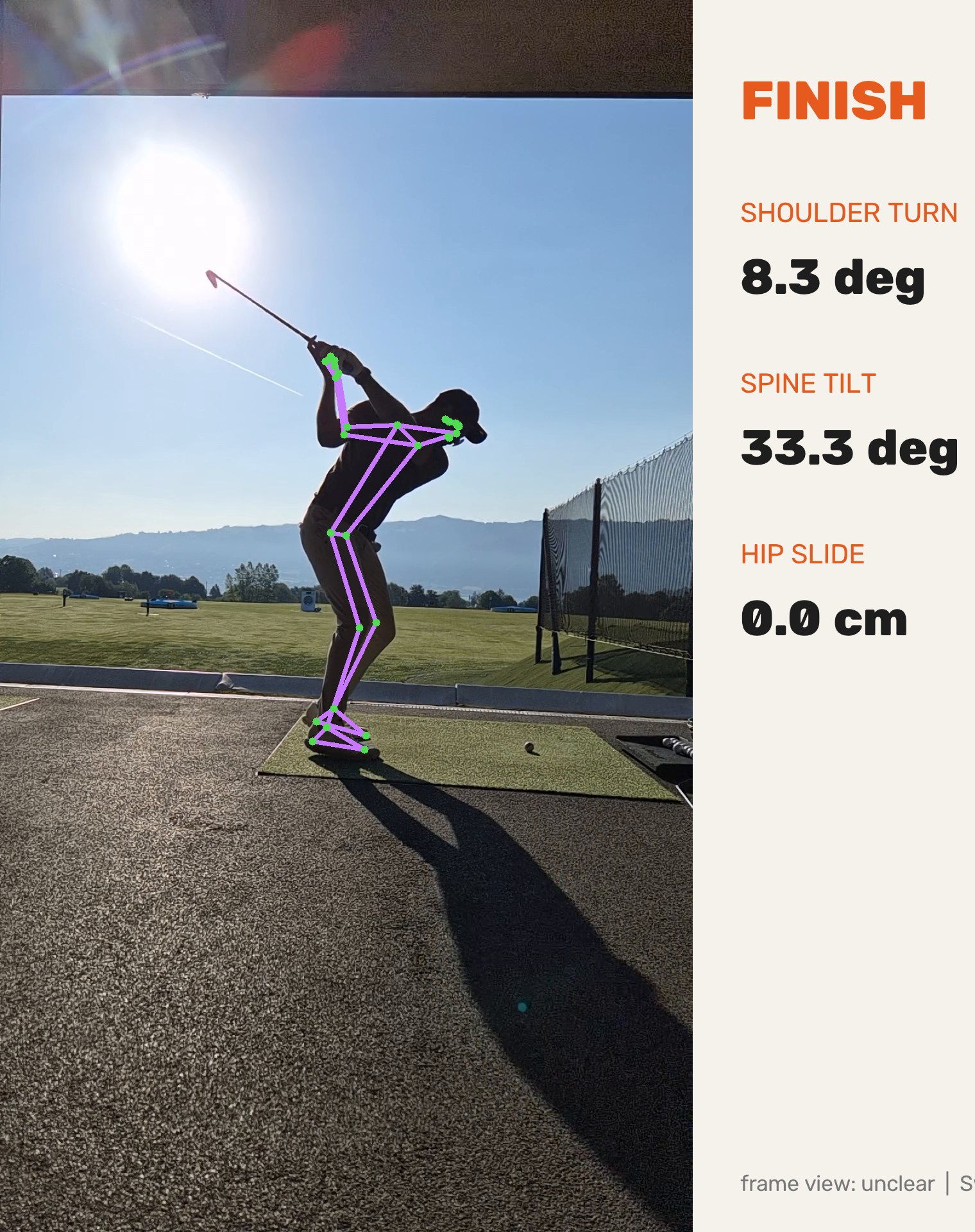
You're filming into the sun, so you show up as a near-total silhouette — I can't see your grip, clubface, or hand detail at all. The camera sits roughly behind you on the target line, which is fine for checking swing plane and posture, but the heavy backlight and a couple of near-identical frames make some phases hard to read. Next time, put the sun behind the camera (film with the light on you) and add a face-on angle on another day so I can check grip and weight shift.
Top 3 Priorities
Make a real shoulder turn — rotate your torso, don't lift your arms
This has been your #1 priority and it's still the biggest limiter: your shoulder turn measured 3.7° this session (it was 13.9° before), so essentially zero coil. Without turning your back toward the target you have no power source and contact will always be inconsistent. Everything else improves once you rotate.
▸ Cross-arm shoulder turn
Without a club, cross your arms over your chest and take your golf posture. Turn your lead shoulder until it points at the ball, feeling your back muscles stretch — try to get your chest facing away from the target. Do 10 slow reps, then keep that same body turn when you add the club.
▸ Back-to-the-target check
Make slow backswings and pause at the top. Look up: your back should be turned toward where you're aiming. If your chest is still facing the ball, you lifted instead of turned. Repeat until turning feels normal, then speed it up gradually.
Clear your hips and rotate through to a full finish
Your hips were only 1.1° open at impact and your finish turn was 8.3° — you're stopping your body and letting the arms do the work. Clearing the hips lets you shift weight forward, hit down on the wedge, and finish in balance.
▸ Belt-buckle to target
Make slow half-swings and focus on turning your belt buckle to face the target through impact and into the finish. Feel your lead hip clear back and around behind you rather than sliding toward the ball.
▸ Hold the finish
After each shot, freeze in your finish for a two-count: weight on the lead foot, chest and belt buckle facing the target, trail heel off the ground. If you can't hold it, you didn't rotate through — do it every single rep until it's automatic.
Stand taller — flatten the rounded upper back at address
Your spine tilt and knee flex numbers are good, but the rounded/hunched upper back you show in the frames physically blocks your shoulders from turning. A tall, straight spine is what makes the #1 priority (the turn) possible.
▸ Proud chest setup
At address, set your posture then lift your chest slightly so your upper back is straight, not slumped. Bend forward only from your hip crease. It should feel like you're standing tall while hinging at the hips.
▸ Club-on-spine drill
Hold a club vertically down your back, touching your head, upper back, and tailbone. Bend into your golf posture keeping all three points in contact. This teaches the straight-spine feel that frees up your rotation.
Phase Breakdown
Setup5.0
Observed: Your measured spine tilt is 39.3° — right in the healthy 15-45° range for an iron — and knee flex reads 36.9° lead / 28.3° trail, so you're not standing stiff-legged. In the silhouette, though, your upper back looks rounded/hunched rather than tilting from the hips.
Good: Good forward bend from the hips and reasonable knee flex — the athletic foundation numbers are there.
Improve: Flatten the rounded upper back. Feel like your chest is 'proud' and the bend comes from your hip crease, not from slouching the shoulders. A tall, straight spine gives your shoulders room to rotate.
Takeaway4.0
Observed: From address into the takeaway the club barely changes position between frames — the motion is coming almost entirely from the hands and arms with the torso staying square (shoulder turn barely off zero this early).
Good: Head stays very steady and the lower body is quiet — no early sway.
Improve: Start the takeaway by turning your chest and shoulders, not by picking the club up with your hands. Feel the club, arms, and chest move away together as one unit for the first foot or two.
Backswing2.0
Observed: This is the core issue: your measured shoulder turn at the top is just 3.7° and hip turn 0.7°. That means there's essentially no rotation — the club is being lifted with the arms while the body stays facing the ball. Head sway is tiny (1.8 cm), which is good, but only because nothing is turning.
Good: Excellent stability — head and lower body are rock-steady, so once you add rotation it will be around a solid center.
Improve: You need to turn your back toward the target. Aim to get your lead shoulder over or behind the ball and your shoulders to ~80-90°. Right now you're lifting, not coiling — that's the difference between a wedge that only chips forward and one with real power.
Transition3.0
Observed: Measured tempo is 4.0:1, a touch slow versus the 2.5-3.5 reference, and X-factor is only 3° — because there's no shoulder or hip turn, there's no separation to create. The clip actually held 3 swings with very inconsistent tempo (4.0 and 0.06), so this reading is approximate.
Good: You're not rushing or lunging — the sequence is calm.
Improve: Once you build a real turn, let the lower body start the downswing by rotating the hips toward the target while the arms drop. Separation (X-factor) is what a wedge needs for crisp contact — but rotation has to exist first.
Downswing3.0
Observed: With almost no backswing turn there's little to sequence on the way down — the arms simply return the club to the ball. Hard to judge plane from the silhouette, though the club stays in front of the body.
Good: No obvious over-the-top lunge or casting spike; the path stays fairly compact.
Improve: Feel your belt buckle turn to face the target as your arms come down. The downswing power should come from unwinding your body, not swiping with the hands.
Impact3.0
Observed: Measured hips-open at impact is 1.1° and hip slide 0 cm — your hips are essentially square and stacked over the ball at contact, when they should be rotating open. Head stays nicely behind (sway 1.1 cm).
Good: Steady head and a stable base at impact — good centeredness.
Improve: Get your hips clearing — aim for 30-40° open at impact. Feel your lead hip pull back and around behind you so your body, not your hands, delivers the club. This also helps you get your weight onto the lead foot.
Follow-through3.0
Observed: The frame labeled 'finish' actually shows an arms-up backswing-style position, and the measured finish shoulder turn is only 8.3° with spine tilt still 33° — so you never rotate through to a balanced, chest-to-target finish.
Good: You do get the arms up and stay balanced on your feet — the athletic stability is there to build on.
Improve: Swing all the way through to a full finish: weight on the lead foot, belt buckle and chest facing the target, back heel up. Target 75°+ of rotation at the finish. 'Hold your pose' for a two-count every rep.
Club Notes
With a pitching wedge you don't need a huge swing, but you do need body rotation to hit down and through the ball for crisp contact and consistent distance. The arms-only lift you're using now will produce weak, thin or fat contact. Even a controlled 3/4 wedge swing should have a clear shoulder turn back and hips clearing through — think 'rotate and cover the ball,' not 'lift and hit.'
From Coach AI
Here's the good news: the hardest thing to teach — a quiet, stable center — you already own. Your head barely moves, your posture angles are healthy, and you stay balanced. That's a fantastic platform. The one thing holding you back is turning your body instead of lifting your arms, and it's a very fixable feel, not a rebuild. Spend your next few sessions just grooving the shoulder turn with the cross-arm drill until 'turn my back to the target' feels natural — once that rotation shows up, your wedge contact and distance will jump noticeably. You're closer than the score suggests.
Notes
No notes yet. Tap Add to write one.
Launch Monitor
Add TrackMan / Garmin / Mevo numbers from your shot to ground the coaching in what the ball actually did — then Reanalyze.
Ask the Coach
Ask a follow-up question about this swing — e.g., “why is my backswing scored low?” or “what should I feel during the transition?”