Overall
5.0
/ 10
PW
Jun 30, 2026, 11:06 AM
Camera: down-the-line (suboptimal)
You have some genuinely strong fundamentals — excellent tempo (3.0:1), rock-steady head (under 1 cm of sway), good spine angle at address (~36°), and a balanced finish. What's holding the whole swing back is a severe lack of body rotation: a ~14° shoulder turn and ~4° open hips at impact mean you're swinging almost entirely with your arms. Fix the turn and this swing improves quickly across every phase, because the stable platform underneath it is already there.
3 swings detected in this clip — the clearest one was analyzed. Tempo across swings: 3.5:1 ±0.5 — lower spread means a more repeatable swing.
Swing Replay
Original recording (no overlay)
Measured Biomechanics
Measured from 3D pose estimation (±5° / ±2 cm). Green bands are beginner reference ranges for a full iron swing, not absolutes.
Key Frames
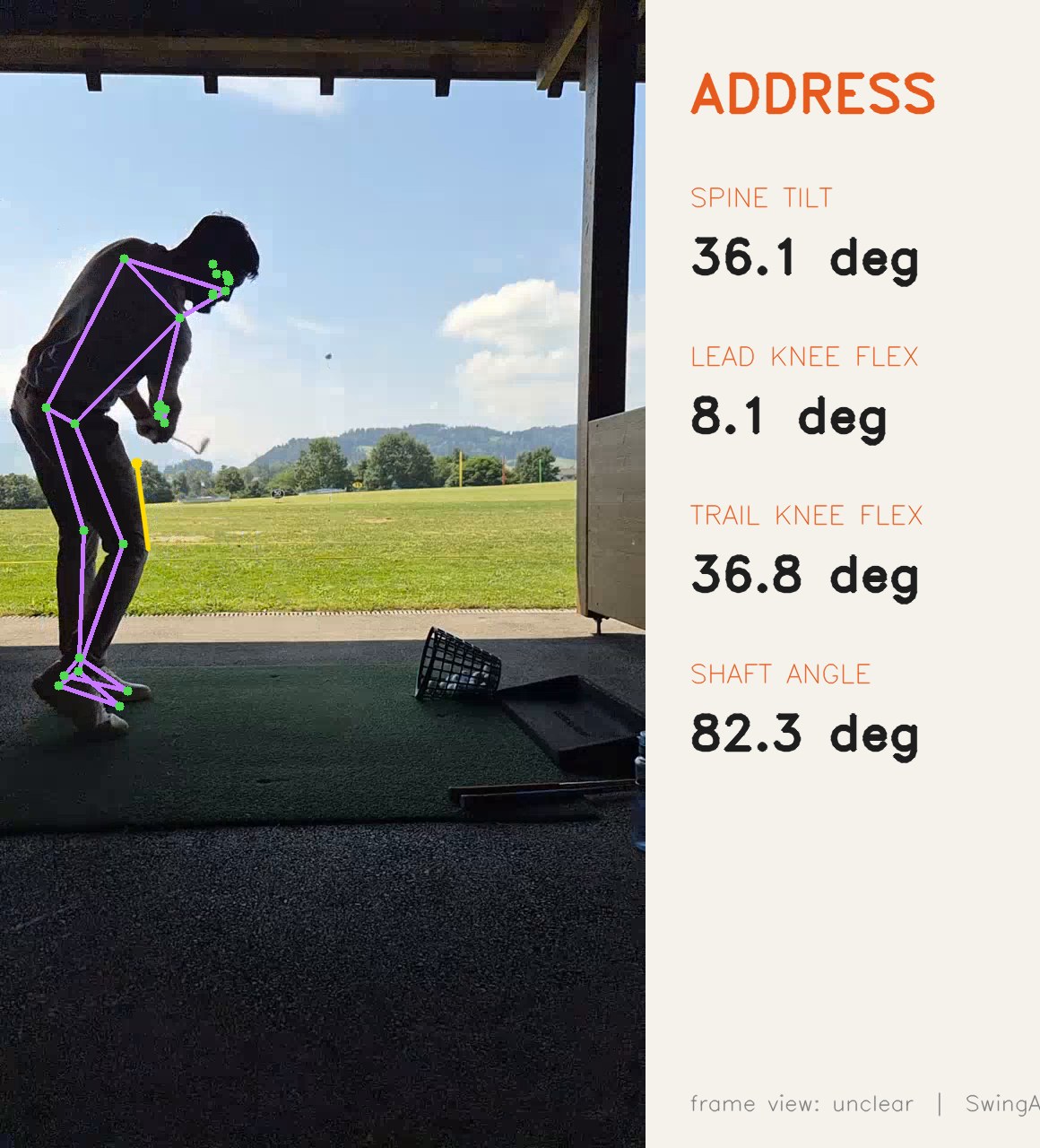
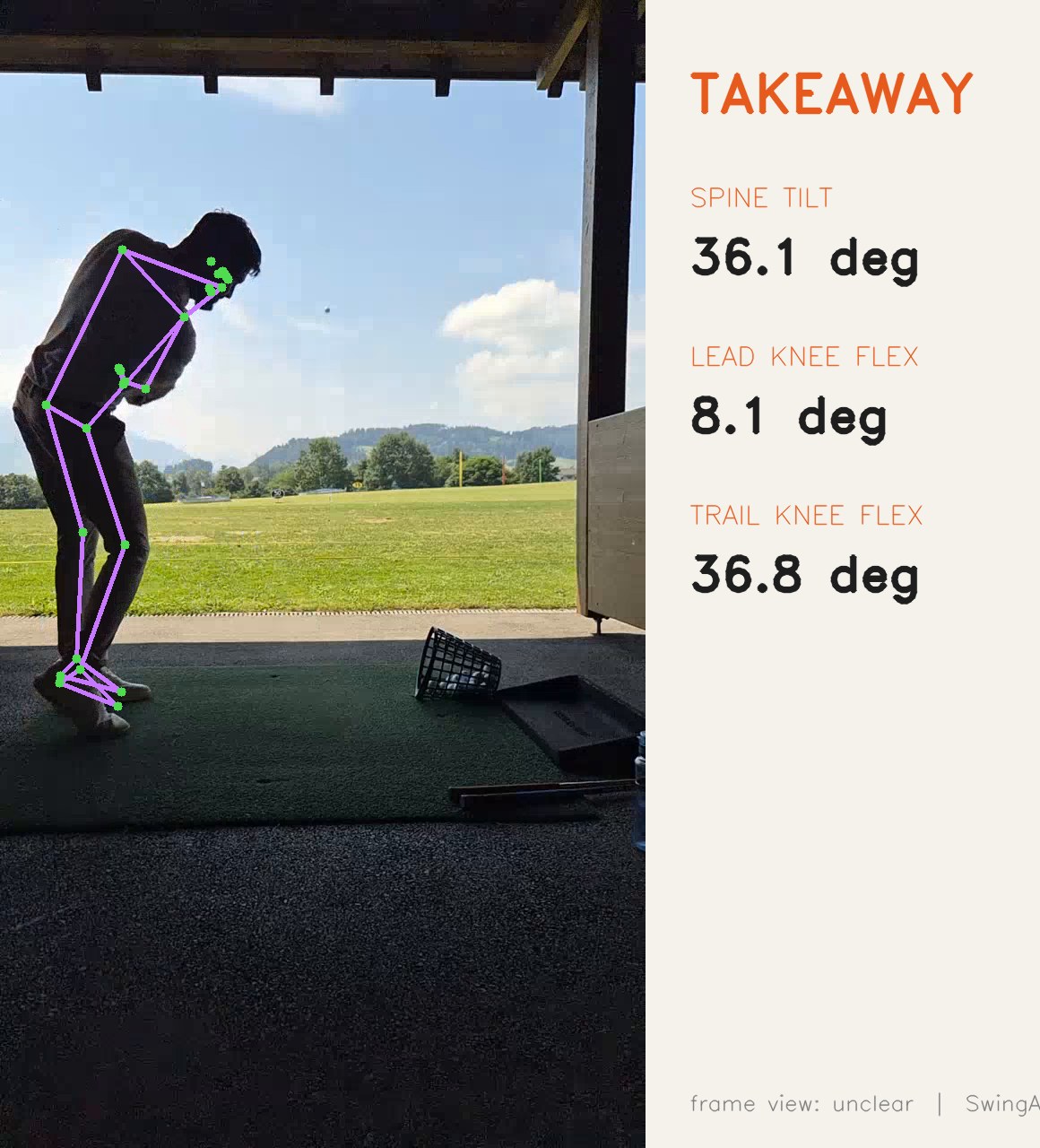
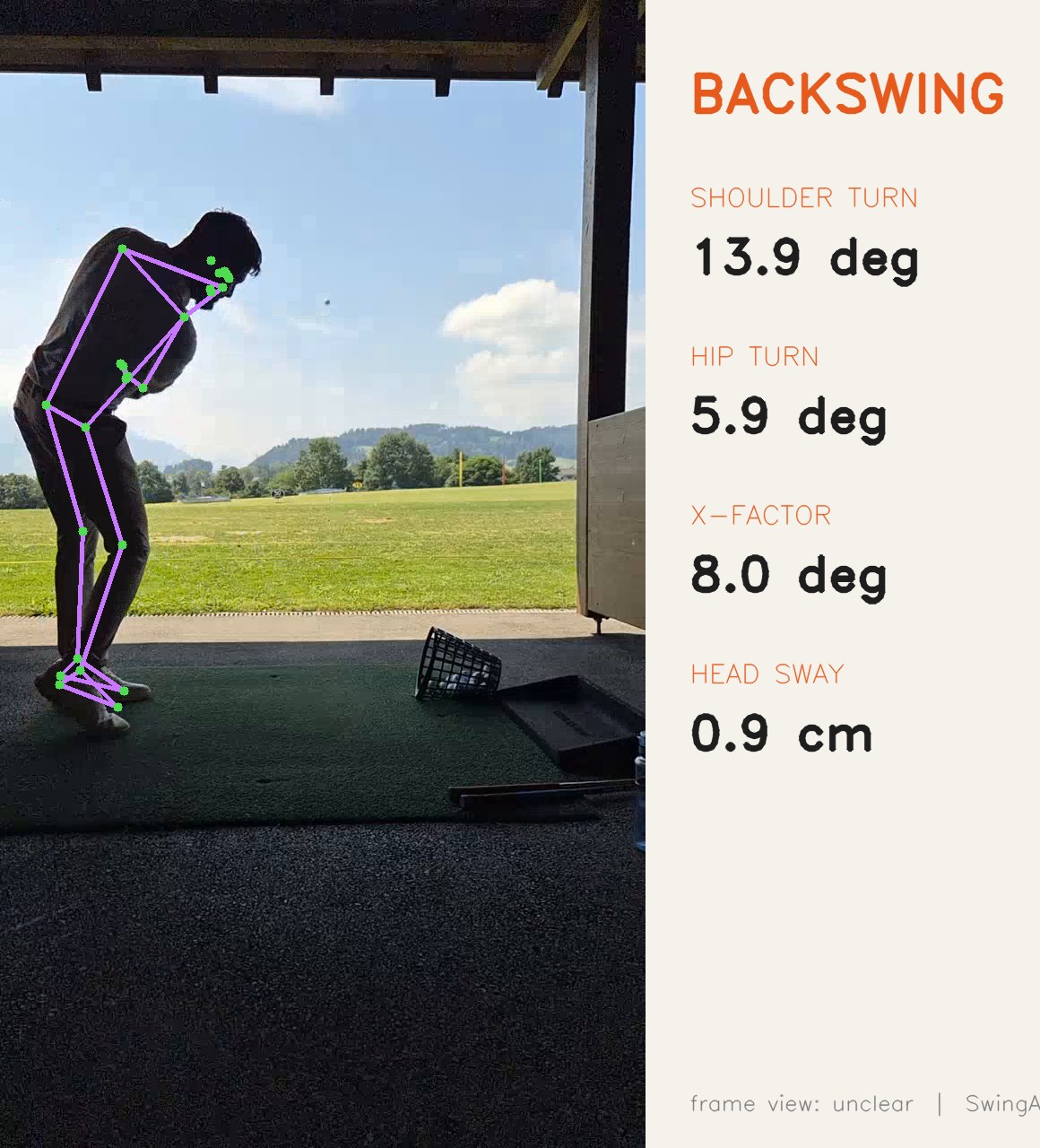
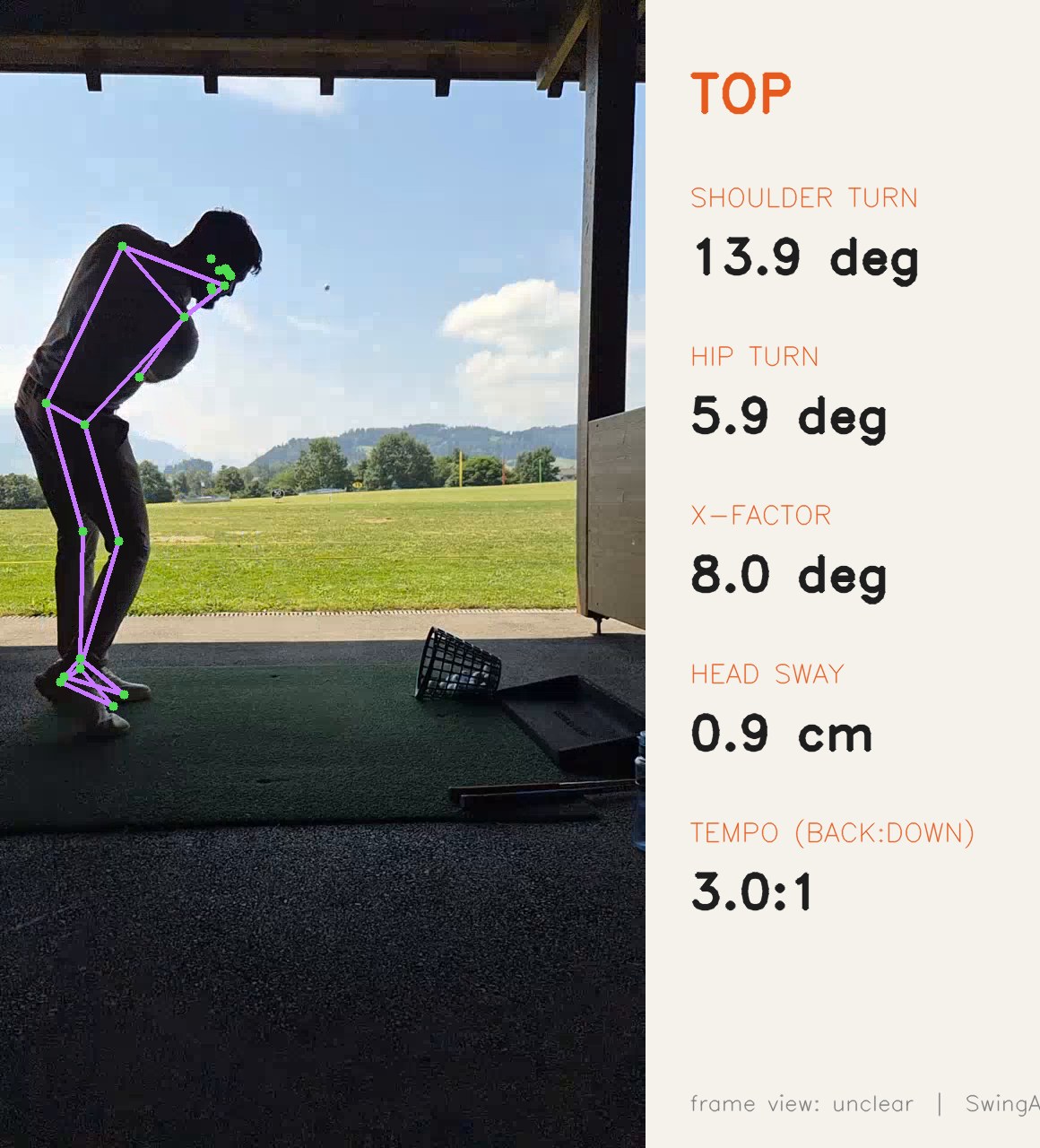
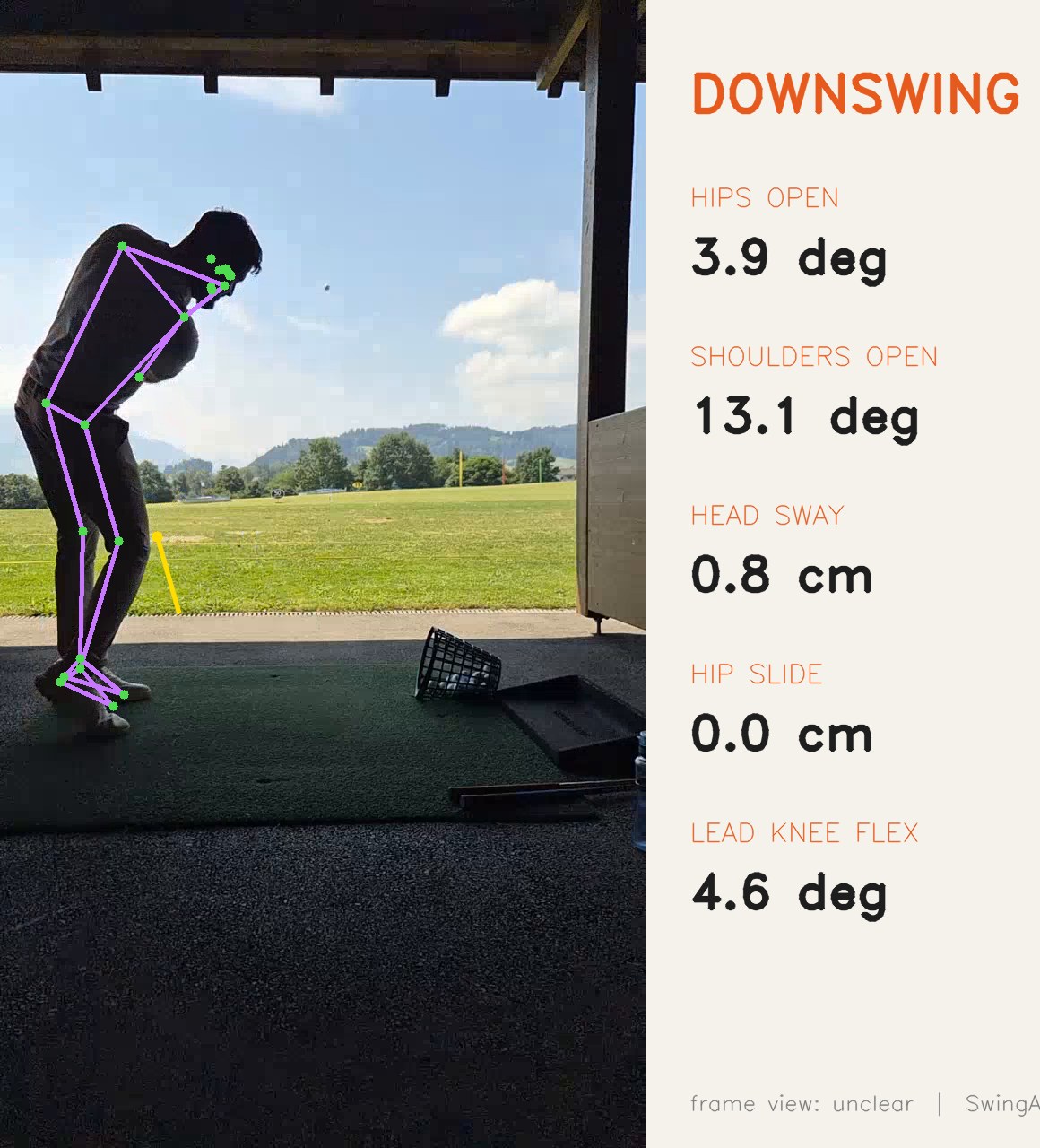
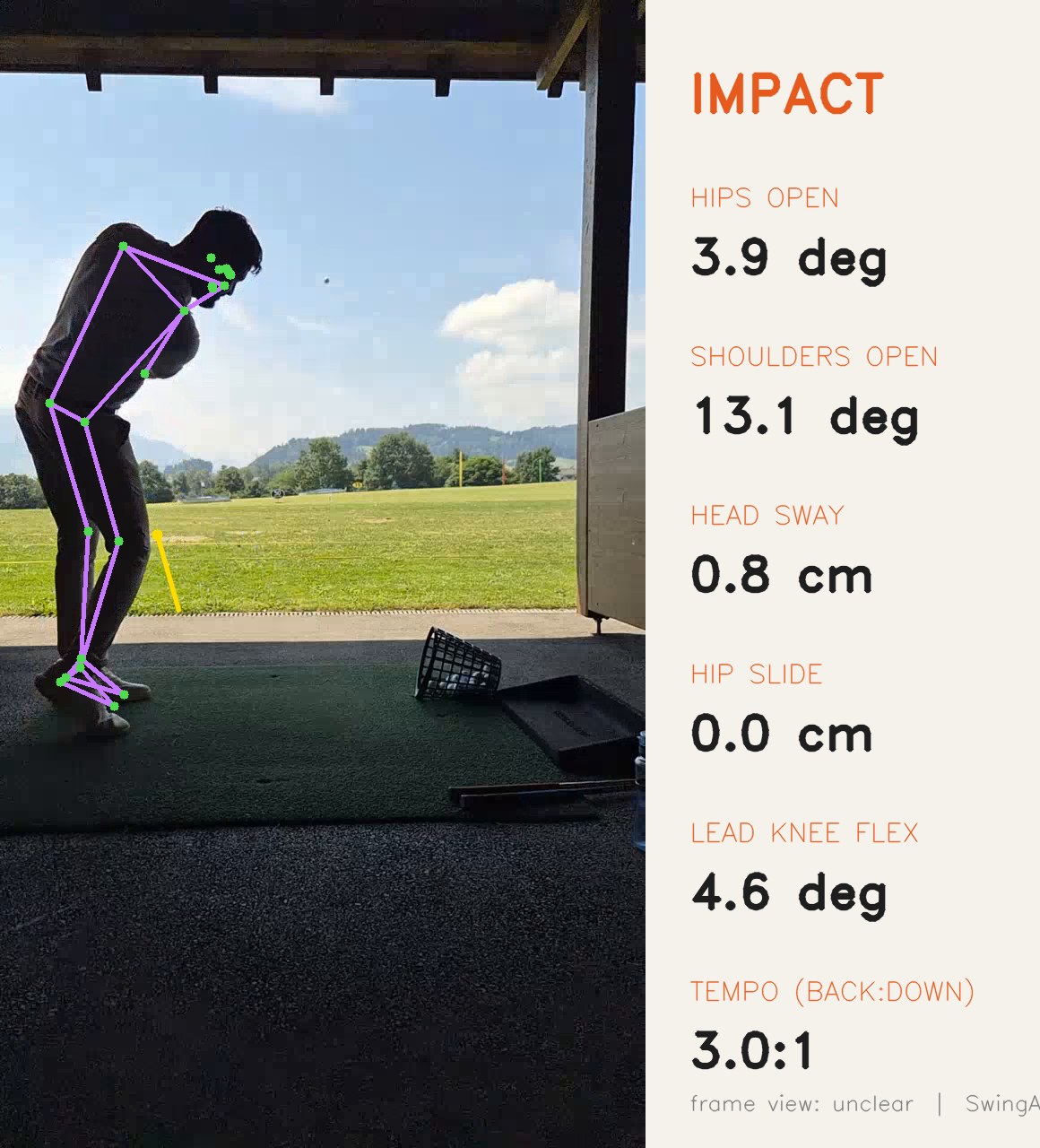
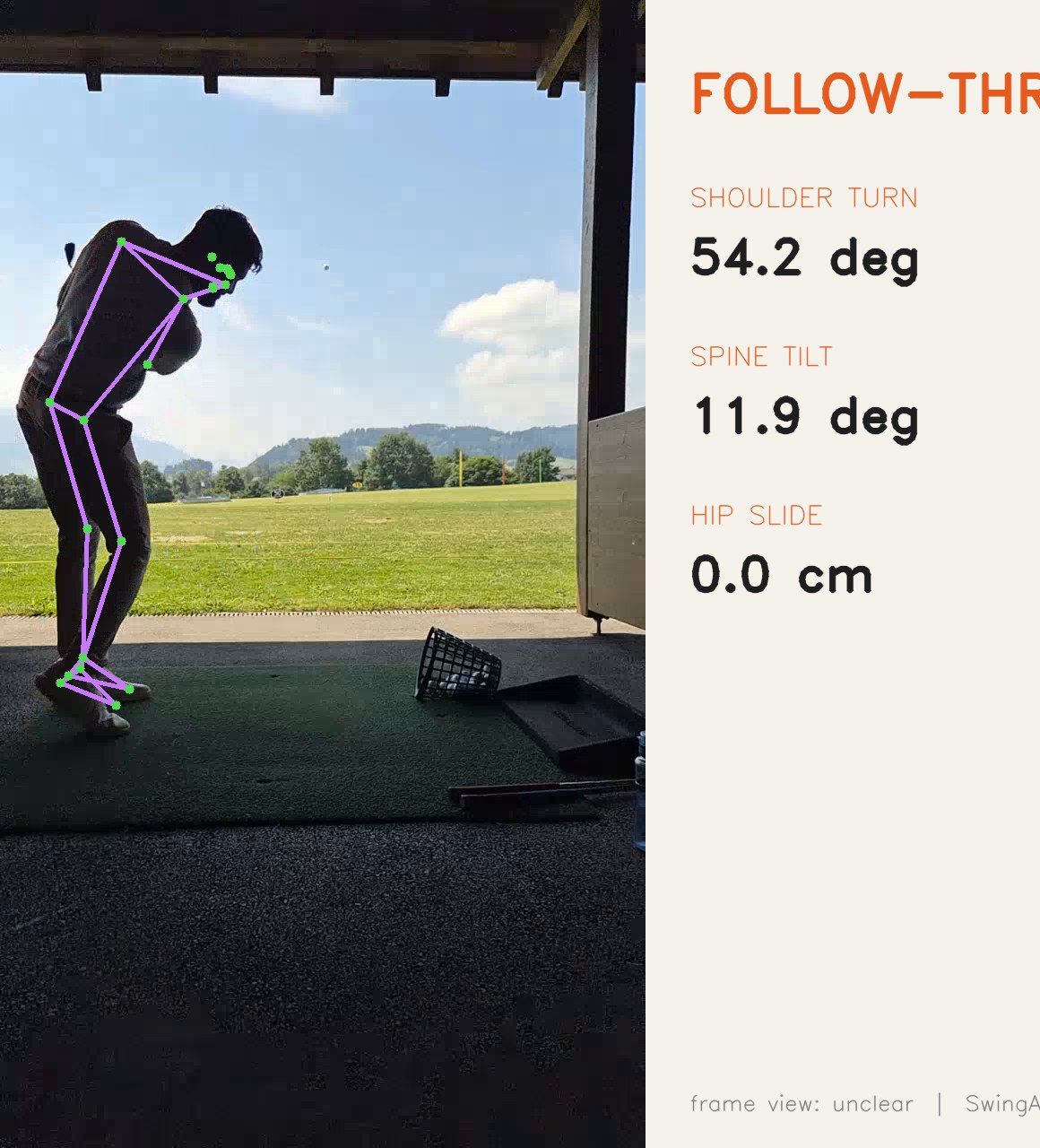
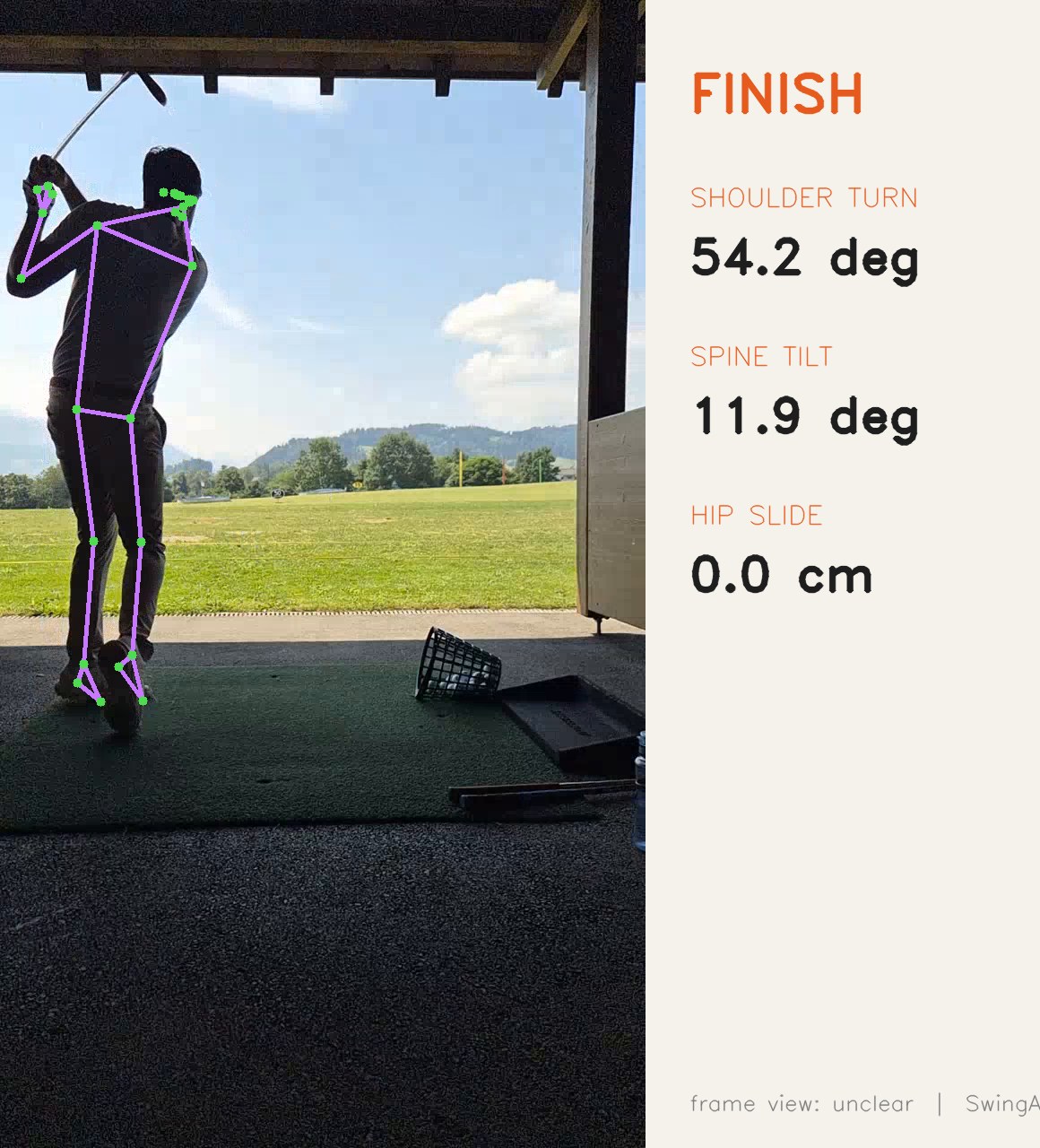
You're filmed roughly down-the-line (camera behind, looking out toward the field) — the finish frame clearly shows your back with the club over the lead shoulder. The biggest problem is the lighting: you're heavily backlit against a bright sky, so you appear as a silhouette. That makes it very hard to see your grip, hand position, clubface and exact shaft path. The pipeline also flagged 3 swings in this clip, so a couple of the labeled frames (takeaway through impact look nearly identical) may be slightly mismatched. For your next video, film from the side at hip height with the sun behind the camera, not behind you.
Top 3 Priorities
Make a much bigger shoulder turn in the backswing
Your shoulder turn measured ~14° at the top versus a beginner goal of 80-105°. This is the single biggest limiter in your swing — almost all of your power, swing width and ball-striking consistency come from coiling your torso. The good news is your steady head and good finish position prove you have the balance and mobility to do it.
▸ Back-to-the-target turn
Without a ball, take your setup and slowly turn until your back faces the target (or as close as you can get), keeping your lead arm fairly straight. Hold it for two seconds and feel the stretch across your torso. Do 10 reps, then hit a few easy half-shots trying to reach that same turned position.
▸ Cross-arm shoulder turn
Stand in your golf posture, fold your arms across your chest, and turn your lead shoulder down and behind the ball until it points roughly where the ball is. This isolates body rotation from arm swing so you feel how far the chest should actually move.
Clear your hips through impact
Your hips were only ~3.9° open at impact, where 30-60° is the target. When the body stops rotating, the arms have to flip to square the club, which kills both consistency and compression. Rotating your hips open lets you strike down and through the ball with control.
▸ Belt-buckle to the target
Hit slow three-quarter wedge shots with one thought: finish with your belt buckle pointing left of the target (toward the field, for a right-hander). Exaggerate the feeling of your hips turning open before the ball — it will feel like too much but the camera will show it's about right.
▸ Lead-foot finish hold
Make swings where you intentionally rotate all the way onto your lead foot and hold the balanced finish you already show in your last frame. Feel the hips drive the rotation, not the arms, and freeze for three seconds each rep.
Stand taller and reduce the hunch at address
Your spine tilt number is fine (~36°), but the silhouette shows a rounded upper back and very little knee flex (~8°). A slumped posture restricts how far you can turn your shoulders, so it's directly tied to Priority 1. A taller chest with athletic knee flex frees up your rotation.
▸ Proud-chest setup check
Set up to the ball, then lift your sternum slightly and pull your shoulder blades gently back so your upper back is straight, not rounded. Add a small bend in both knees. You should feel athletic and 'ready,' like a shortstop. Rehearse this 10 times before each range session.
▸ Club-on-spine drill
Hold a club vertically against your back, touching head, upper back and tailbone. Hinge forward from the hips keeping all three contact points, then add knee flex. This grooves the tall, hinged posture that lets your shoulders turn fully.
Phase Breakdown
Setup6.0
Observed: Measured spine tilt at address is ~36°, which is right in the ideal 15-45° window for an iron. However, your lead knee flex measured only ~8° (quite straight) and your upper back looks rounded/hunched in the silhouette rather than a tall, athletic hinge from the hips. Stance width looks reasonable for a wedge.
Good: Spine tilt of ~36° is textbook, and your stance looks stable and balanced over the ball.
Improve: Add a touch more flex in both knees (you're standing fairly tall in the legs at ~8° lead-knee bend) and feel like you bend forward from the hip sockets with a straighter, prouder chest instead of slumping the shoulders down toward the ball.
Takeaway5.0
Observed: Hard to judge club path precisely through the silhouette, but the body looks very quiet and the move starts mostly with the arms/hands rather than a one-piece turn of the chest and club together.
Good: Your head stays very still and your lower body is calm — no early sway off the ball.
Improve: Start the club back by turning your chest and keeping the triangle of arms-and-shoulders connected, so the clubhead, hands and chest move away together as one unit.
Backswing3.0
Observed: This is the headline issue. Your measured shoulder turn at the top was only ~14° and hip turn ~6°, with an X-factor of just 8°. Even allowing for some error from the backlit silhouette, the frames clearly show a very short, arms-only backswing with the chest still pointing at the ball at the 'top'. Head sway was excellent at ~0.9 cm.
Good: Rock-solid stability — under 1 cm of head sway means you're rotating around a stable center, which is a great foundation to build a bigger turn on.
Improve: You need dramatically more shoulder rotation. A beginner target is 80-105°, and you're at ~14°. Feel like you turn your lead shoulder behind the ball until your back faces the target. This is where almost all your distance and consistency will come from.
Transition5.0
Observed: Tempo measured 3.0:1 (session average 3.5±0.5), which is squarely in the healthy 2.5-3.5 range — nice and unrushed. But because the backswing was so short, there's little stored coil (X-factor only ~8°) to release.
Good: Excellent tempo — you're not snatching it from the top, which is a habit many beginners struggle with.
Improve: Once you build a fuller turn, let the lower body (lead hip) start the downswing first while the arms drop. Right now there's almost no separation to use.
Downswing4.0
Observed: With so little turn going back, the down-move is again very arm-dominated and the chest stays facing the ball. Head position stays stable, which is good.
Good: You stay centered and behind the ball — no lunging or sliding toward the target.
Improve: Lead with the rotation of your hips and torso rather than throwing the arms at the ball. A bigger backswing turn will give you something to actually unwind through here.
Impact4.0
Observed: Measured hips open only ~3.9° at impact (shoulders ~13°), with essentially zero hip slide. Ideally the hips are 30-60° open at impact for a wedge. You're hitting with a fairly square, closed-down body — power and crisp contact come from the body clearing.
Good: Great stability — head sway ~0.8 cm and a steady base means you're returning to a consistent position.
Improve: Get your belt buckle rotating toward the target through the strike so your hips are well open at impact. Closed hips force the arms to flip and rob you of compression on the ball.
Follow-through6.0
Observed: The finish frame is your best position — you've rotated onto your lead foot with the club up around your lead shoulder and good balance. Measured finish shoulder turn was ~54° (the target is 75+), and finish spine tilt straightened nicely to ~12°.
Good: Balanced, held finish up on the lead side with the club fully released over the shoulder — this shows you CAN rotate fully when momentum carries you through.
Improve: Get to this same rotated position earlier and more deliberately. If you can finish this turned, you have the mobility to make a much bigger backswing too.
Club Notes
With a pitching wedge, a slightly shorter, controlled swing is actually appropriate — but your current ~14° turn is far shorter than even a stock wedge needs. Ball position should be roughly center for a PW, and because it's a shorter, more lofted club you don't need to swing hard; let the loft do the work. Focus on a crisp, descending strike driven by body rotation rather than scooping with the hands. The experimental club detector read your shaft at ~82° at address and ~74° in the downswing, but given the silhouette I'd treat those loosely — your body rotation is the clearer priority.
From Coach AI
There's a really solid foundation here that's easy to overlook: your tempo (3.0:1) is exactly where good players want it, your head barely moves (under 1 cm of sway), your address posture angle is textbook, and your finish is balanced and fully released. Those are the hard-to-teach things, and you already own them. The one thing standing between you and much better, more powerful shots is simply turning your body more — both going back and through. Make that bigger shoulder turn your obsession for the next few sessions and you'll be amazed how much more solid and effortless your wedge shots feel. And please grab one video from the side with the sun in front of you next time — I'll be able to give you even sharper feedback on your grip and club path.
Notes
No notes yet. Tap Add to write one.
Launch Monitor
Add TrackMan / Garmin / Mevo numbers from your shot to ground the coaching in what the ball actually did — then Reanalyze.
Ask the Coach
Ask a follow-up question about this swing — e.g., “why is my backswing scored low?” or “what should I feel during the transition?”