Overall
4.0
/ 10
PW
Jun 30, 2026, 11:12 AM
Camera: face-on (suboptimal)
Your tempo (3:1), head stability, and balanced finish are real strengths. But the swing is dominated by one fundamental flaw: almost no body rotation. A ~14° shoulder turn and ~4° open hips at impact mean you're swinging with arms only, which caps both power and consistency. Because this is the same shoulder-turn number as last session, the score dips slightly — the priority hasn't moved yet.
Since Last Session
Last session your #1 priority was 'make a much bigger shoulder turn,' and this swing measured the exact same ~14° shoulder turn (with X-factor still ~8°). So the turn hasn't improved yet — it stays as priority #1, and I'd really lean into the back-to-target and cross-arm drills before your next session. On the positive side, your previous 'complete the finish' work is paying off: this finish is fuller and well-balanced (54° rotation, up on the lead foot), so that habit is heading the right way. Tempo also held steady at a great 3:1.
3 swings detected in this clip — the clearest one was analyzed. Tempo across swings: 3.5:1 ±0.5 — lower spread means a more repeatable swing.
Swing Replay
Original recording (no overlay)
Measured Biomechanics
Measured from 3D pose estimation (±5° / ±2 cm). Green bands are beginner reference ranges for a full iron swing, not absolutes.
Key Frames
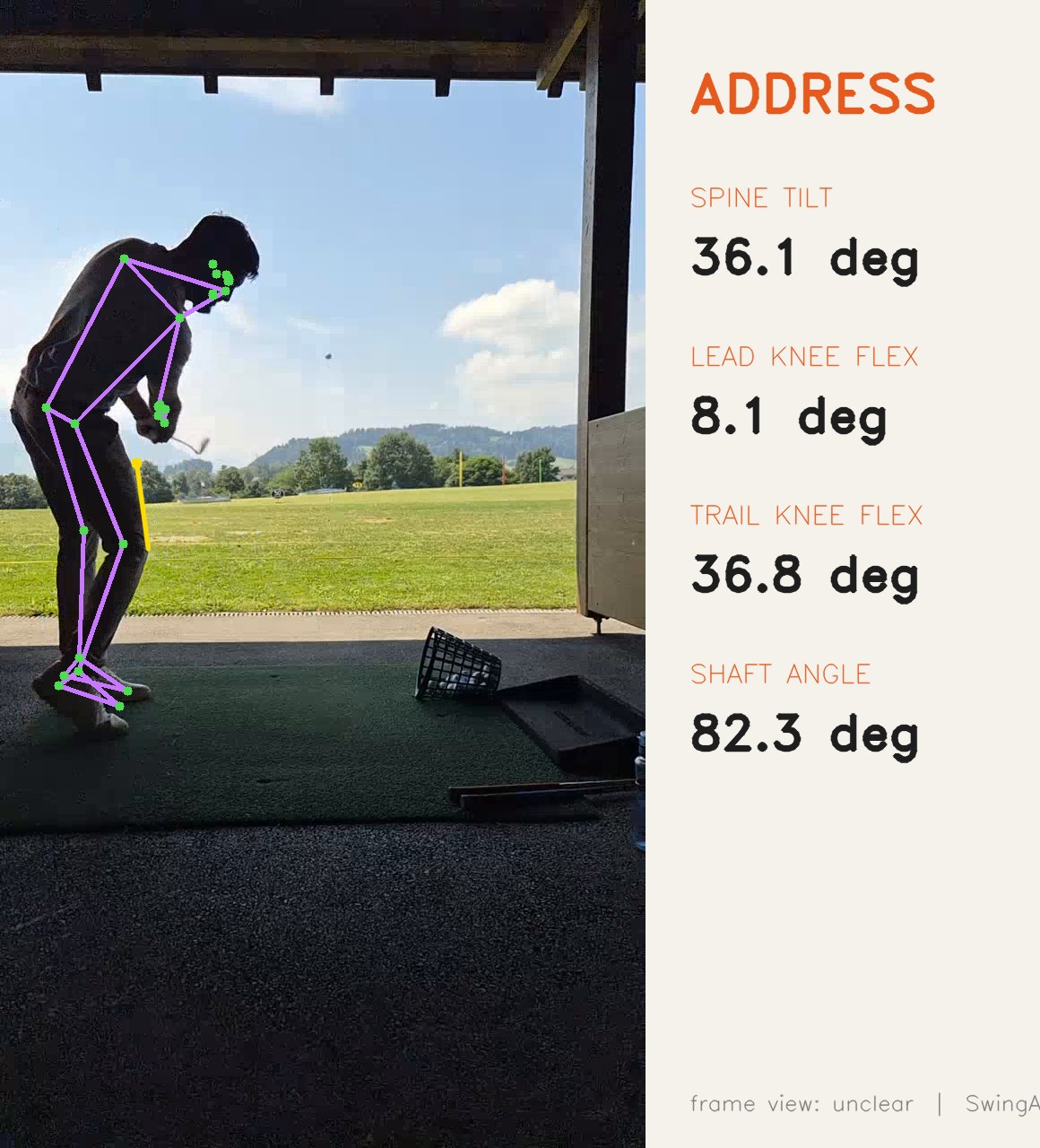
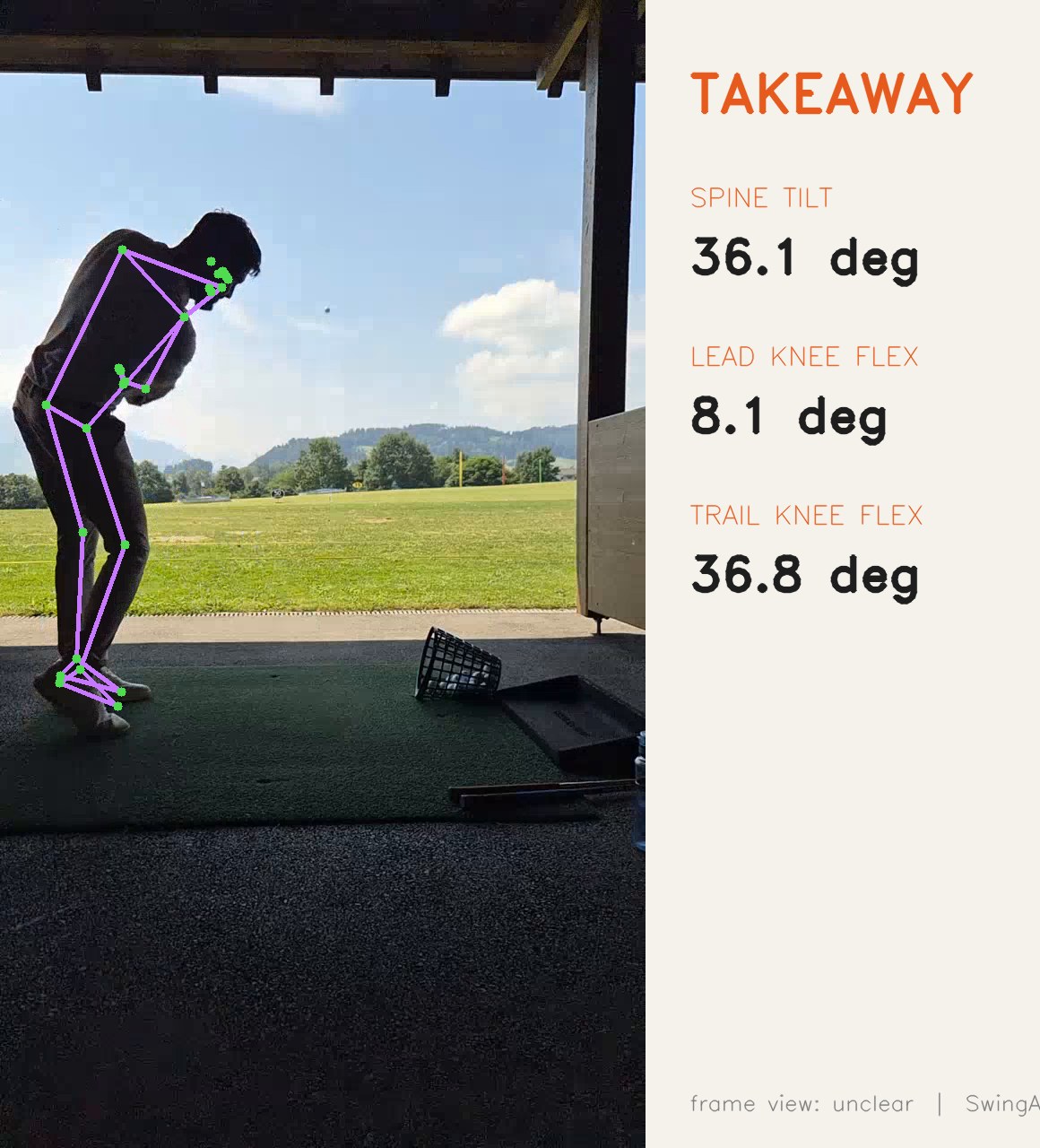
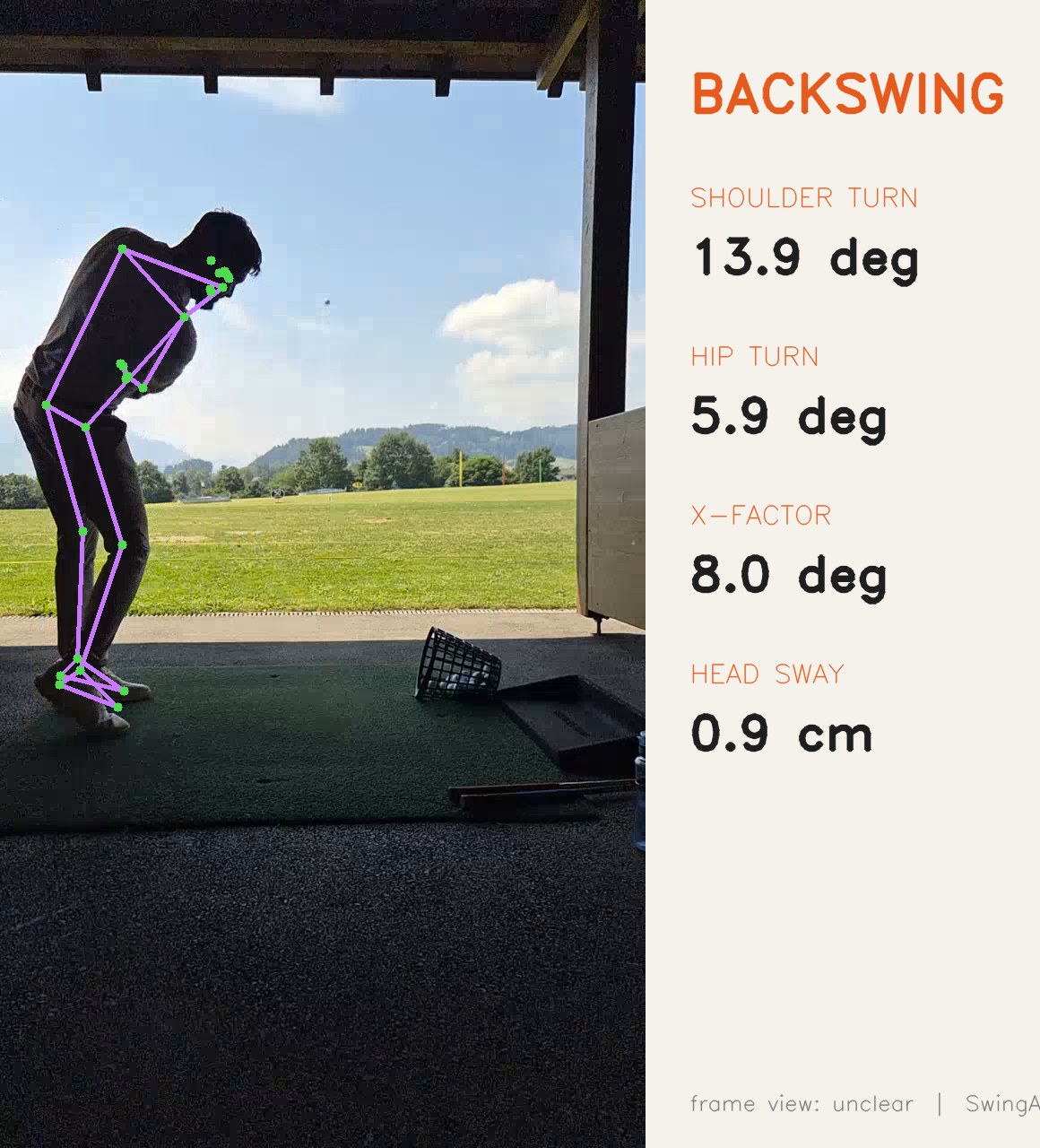
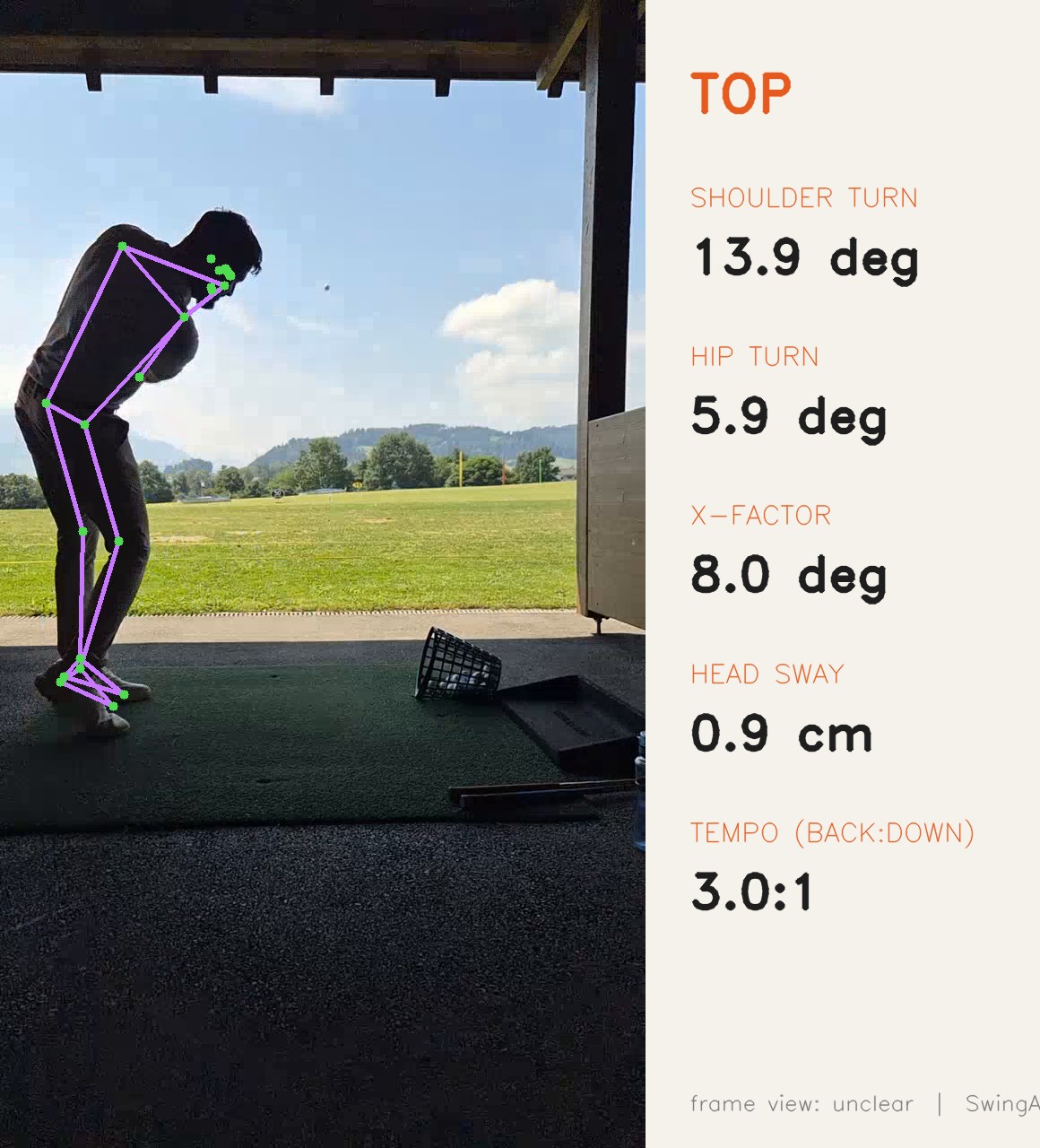
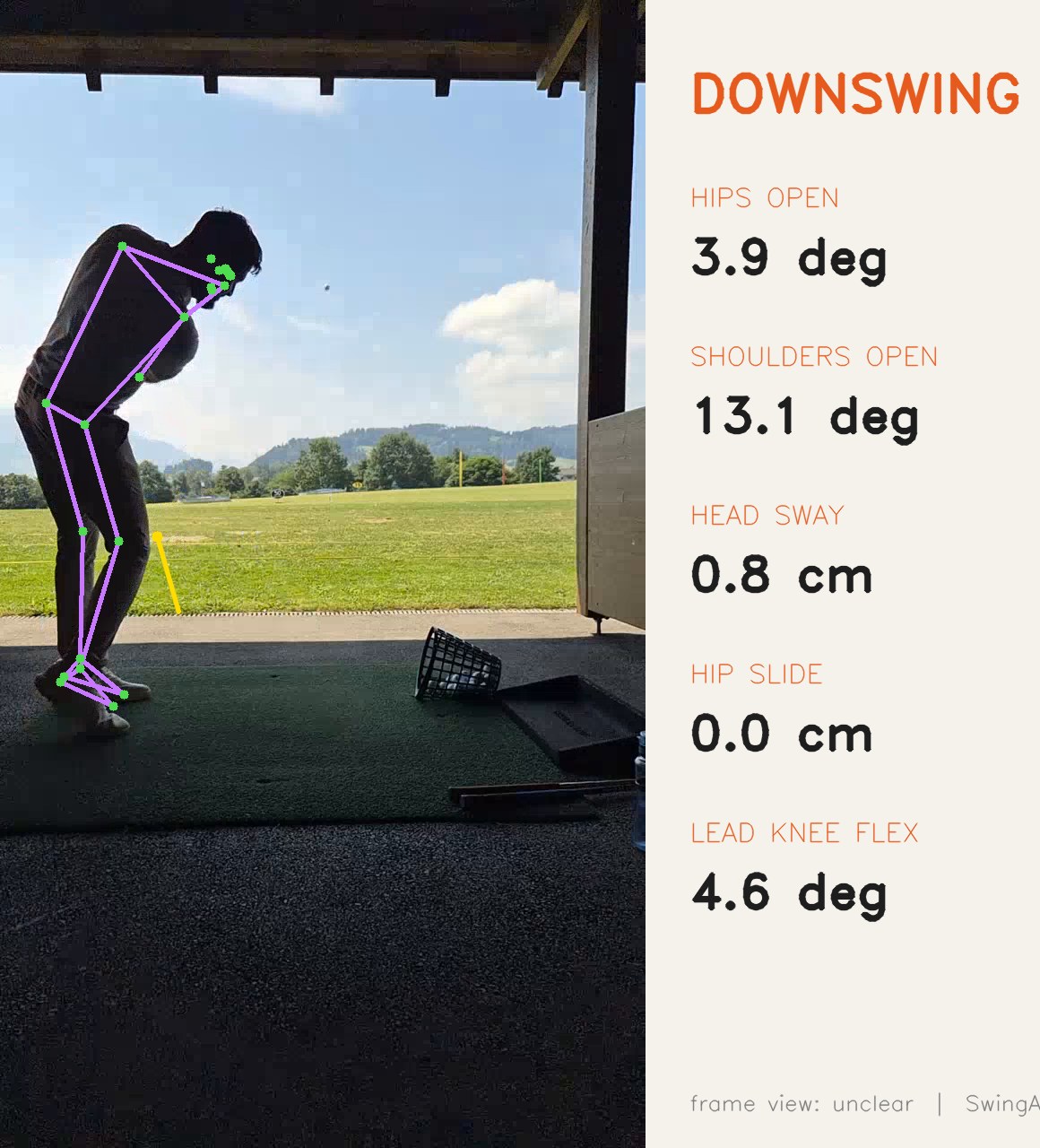
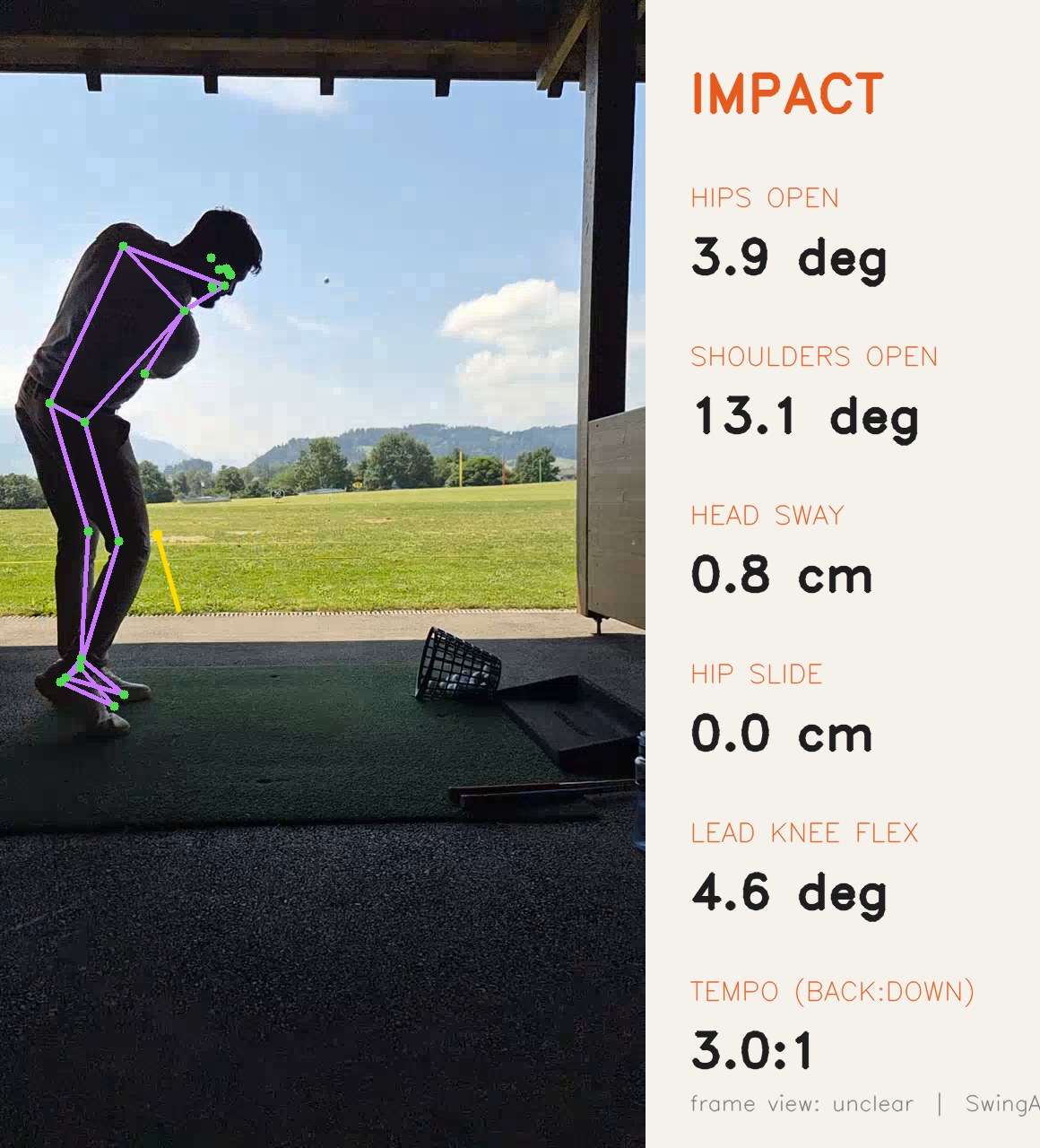
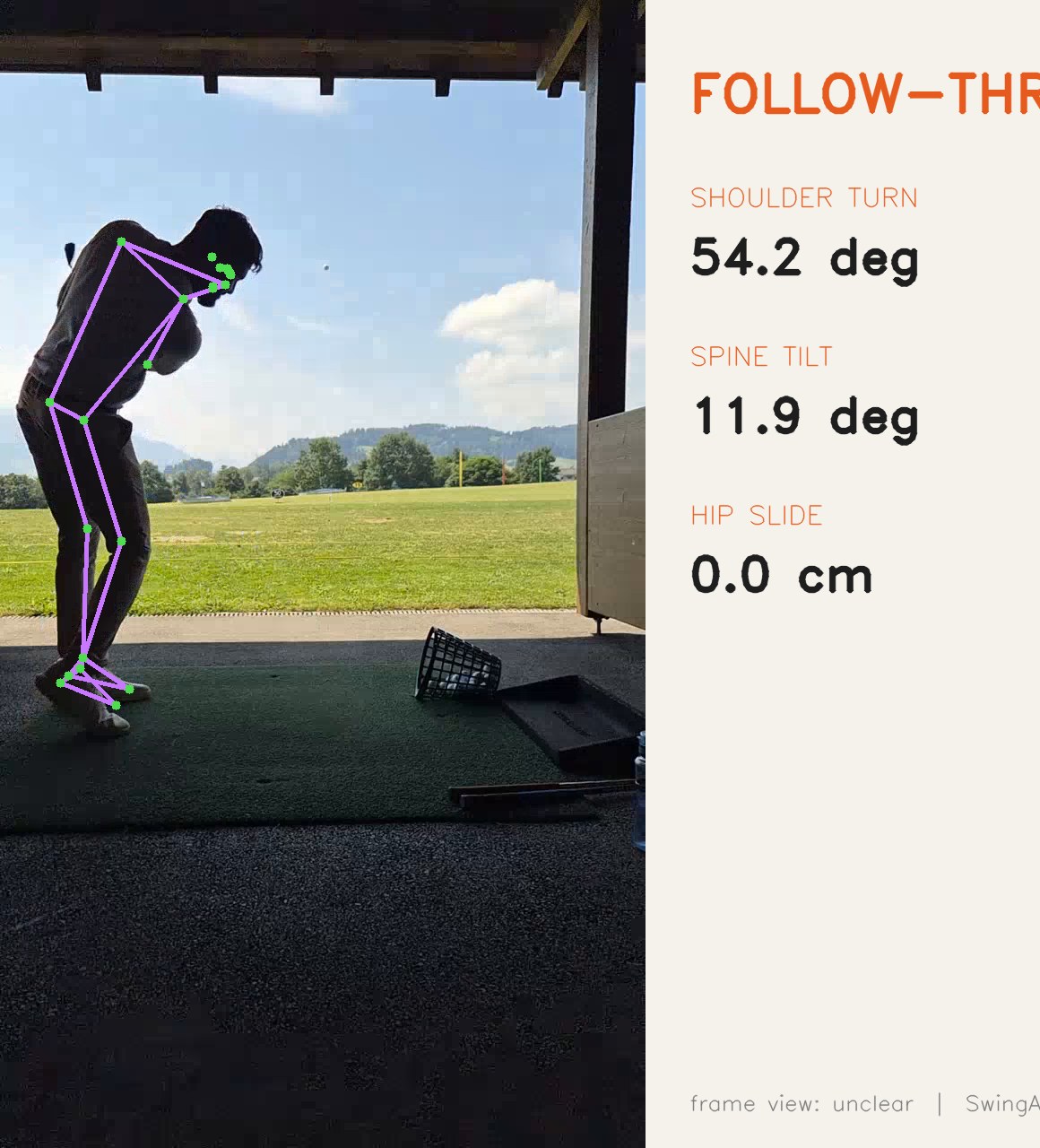
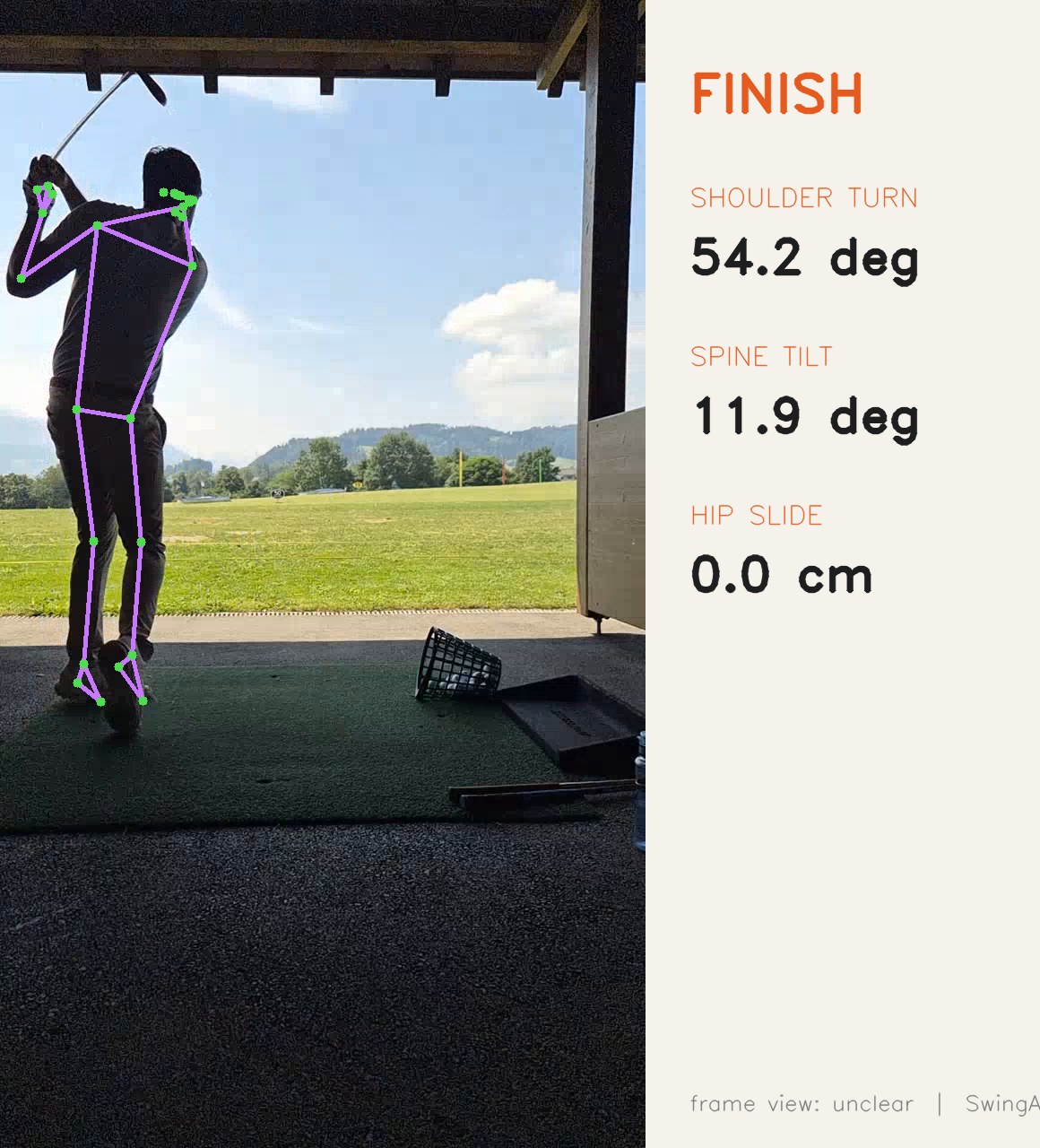
You're heavily backlit against the bright range opening, so you appear almost entirely in silhouette. That hides your grip, clubface, and any spine/shoulder detail, and the slightly oblique angle makes it hard to be precise about path. For best results next time, film with the sun behind the camera (you lit from the front) and stand squarely face-on (camera level with your hands, target line going straight left-to-right). The good news: rotation and balance — the things that matter most for you right now — are still readable, and the 3D pose numbers fill in the rest.
Top 3 Priorities
Make a real shoulder turn in the backswing (rotate, don't lift)
Your shoulder turn measured ~14° — it should be 80°+. This is unchanged from last session and is the one fix that will transform your ball-striking and distance. Right now your arms do all the work; turning your torso gives the club a long, powerful arc instead of a short, steep lift.
▸ Back-to-target drill
Take your address, then slowly turn until your back faces the target (the range) and your lead shoulder sits under your chin. Hold it for 3 seconds and feel how much more you've coiled than usual. Do 10 reps slowly, then try to hit a few half-shots keeping that same feeling of 'showing my back to the target.'
▸ Cross-arm chair turn
Cross your arms over your chest, get into your golf posture, and rotate your shoulders back and through as if hitting a ball. Feel the trail shoulder go back and around (not up). This teaches your body that the backswing is a turn, not an arm lift — then add the club back in.
Clear your hips through impact
Your hips were only ~4° open at impact with no slide toward the target. Letting the lower body lead and rotate open (aim 30°+) is what creates speed and lets you compress the ball instead of flipping at it with the hands.
▸ Step-through drill
Hit slow half-shots and let your trail foot step toward the target right after impact, finishing fully on your lead side. This forces your hips to keep rotating and your weight to move forward instead of hanging back.
▸ Lead-pocket-back feel
In slow motion, start the downswing by turning your lead hip/pocket behind you toward the target. Pause at impact and check that your belt buckle points more toward the target than the ball. Repeat 10 times before full swings.
Athletic setup — soften the lead leg and flatten the back
Your lead knee is nearly locked (8° flex) and your back looks rounded. A stiff lead leg blocks rotation and a rounded back encourages an arm-lift. Matching knee flex and a flatter spine make turning much easier — supporting priority #1.
▸ Mirror posture check
Set up side-on to a mirror. Bend from the hips so your back is straight (like sticking your chest out slightly), then add equal, soft flex to both knees so you feel springy and balanced. Hold and memorize the feeling for 30 seconds.
▸ Bump-and-bounce setup
Before each shot, give both knees a small bounce to make sure neither is locked, then settle into an athletic, ready-to-move posture. This stops the stiff, frozen base that prevents turning.
Phase Breakdown
Setup5.0
Observed: Spine tilt measured ~36°, which is right in the ideal 15-45° band for an iron — nice forward hinge. However, your back looks rounded/hunched in the silhouette rather than flat, and your lead knee is almost locked straight (measured 8° flex) while the trail knee is at 37°. That's an uneven, slightly stiff lower-body base.
Good: Your hip hinge depth (36° spine tilt) is genuinely good and gives you room to swing. Stance width and ball position look reasonable.
Improve: Flatten the upper back so you bend from the hips, not the shoulders, and add matching, athletic flex to BOTH knees (aim for ~20-25° in each). A locked lead leg makes it almost impossible to turn your body — which is your core problem.
Takeaway4.0
Observed: From address to takeaway the club moves but your torso barely does — the chest stays pointed the same direction and the motion is mostly hands and arms lifting. The head stays very steady (sway under 1 cm), which is fine.
Good: Steady head and the triangle of arms/shoulders stays connected early.
Improve: Start the takeaway by turning your chest away from the ball, not by picking the club up with your hands. Feel the lead shoulder move toward your trail hip from the very first move.
Backswing3.0
Observed: This is the heart of the issue. At the top your shoulders turned only ~14° and your hips ~6° (X-factor ~8°). For reference, beginners should reach 80-105° of shoulder turn. You are essentially standing still and lifting the club with your arms — the silhouette at 'top' looks almost identical to address. This is unchanged from your last session (also 13.9°).
Good: Excellent stability — head sway under 1 cm means you're not swaying off the ball, so once you add rotation you won't have to fight a slide.
Improve: You must rotate. Turn your back toward the target so your lead shoulder ends up under your chin. A bigger turn is the single biggest source of power and consistency you're missing right now.
Transition4.0
Observed: Your tempo ratio measured ~3:1, which is textbook — so timing isn't the problem. But because almost nothing coiled in the backswing, there's no stored energy to transition; the lower body never loads or initiates.
Good: 3:1 tempo is excellent and well within the 2.5-3.5:1 target band — keep that rhythm.
Improve: Once you build a real shoulder turn, let the downswing start by bumping and rotating your hips toward the target before the arms come down.
Downswing4.0
Observed: With so little backswing turn, the downswing is again arm-dominant — the body stays bent over and fairly square. Hard to read path precisely in silhouette, but there's no visible sequencing of hips leading. Club detection suggested an upright shaft (~82° at address, ~74° in downswing) but that's unreliable here.
Good: Head stays behind the ball and steady — a solid foundation to build on.
Improve: Power needs to come from the ground up: hips rotate, then chest, then arms. This only works once there's a turn to unwind.
Impact4.0
Observed: At impact your hips are only ~4° open and there's essentially zero hip slide toward the target. Tour players are ~40° open at impact; you're basically square with a stalled lower body, so the arms have to flip the club to square it.
Good: Great head position and stability — you're not lunging or backing up.
Improve: Get your hips opening to 30°+ at impact and your weight onto the lead foot. A clearing lower body lets the club release with much more speed and far better contact.
Follow-through6.0
Observed: The finish is your best frame — you rotated through to ~54° of shoulder turn, got up onto the lead side, and held a recognizable finish with the club behind your head. Spine straightened to ~12°.
Good: You can clearly rotate THROUGH the ball and finish in balance — proof your body is capable of the turn you're missing on the backswing. Nice held finish.
Improve: Finish rotation goal is 75°+; you reached 54°. The bigger your backswing turn becomes, the fuller and more balanced this finish will get.
Club Notes
With a PW you don't need a huge swing, but you still need a turn — wedges are about crisp, ball-first contact, which comes from rotating your body and getting your weight to the lead side, not from steering with the arms. The good news is the PW is the perfect club to groove a fuller turn at half-speed because the shorter shaft is easy to control. Master a 9-to-3 (waist-to-waist) swing with real chest rotation here and it will scale up to the longer clubs.
From Coach AI
Here's the exciting part: your finish frame proves you CAN rotate through the ball in balance — so the ability is already in there, you're just not using it during the backswing. You've also got two things many beginners struggle for years to find: rock-solid head stability and beautiful 3:1 tempo. Add a genuine shoulder turn to that foundation and you'll see an immediate jump in both distance and contact. Pick the back-to-target drill, make it your only focus next session, and let's get that 14° heading toward 70-80°. You're closer than the score suggests.
Notes
No notes yet. Tap Add to write one.
Launch Monitor
Add TrackMan / Garmin / Mevo numbers from your shot to ground the coaching in what the ball actually did — then Reanalyze.
Ask the Coach
Ask a follow-up question about this swing — e.g., “why is my backswing scored low?” or “what should I feel during the transition?”